

Pachacutec: The Visionary Emperor Who Built the Inca Empire
Table of Contents
Pachacutec
Few figures in South American history are as significant as Pachacutec, the ninth ruler of the Inca civilization. Revered as a political and military genius, Pachacutec is credited with transforming a modest kingdom centered in Cusco into the vast Inca Empire, known as Tawantinsuyu. His legacy is felt to this day through engineering marvels like Machu Picchu, as well as through social, political, and administrative reforms that formed the backbone of Inca governance.
Who Was Pachacutec?
Pachacutec, also known as Pachacuti Inca Yupanqui, was born in the early 15th century and ruled from approximately 1438 to 1471 CE. His name means “Earth Shaker” or “He who overturns time and space” in Quechua—a fitting title for someone who redefined the destiny of his people.
He was the son of Viracocha Inca, the eighth Sapa Inca. According to legend, Pachacutec rose to power not by birthright but by merit, defending Cusco during a Chanca invasion when his father and older brother fled. His victory earned him respect, authority, and the throne.
The Rise to Power: A Warrior and a Strategist
Before Pachacutec’s reign, the Inca were a relatively small group among many Andean cultures. But everything changed during the Chanca invasion around 1438. With Cusco under threat, Pachacutec stayed behind and rallied local forces to defend the city. Using both strategic brilliance and divine inspiration (as legends claim he received visions from the sun god Inti), he led the Inca to a decisive victory.
This event marked the beginning of Pachacutec’s transformation from prince to emperor. Soon after, he deposed his father peacefully and began building what would become the largest empire in the pre-Columbian Americas.
Political and Administrative Reforms Introduced by Pachacutec
Pachacutec was not just a conqueror; he was also an administrative innovator. He recognized that military expansion was unsustainable without a strong bureaucratic foundation.
Key Political Contributions:
-
Centralized Power in Cusco: He restructured the government to ensure tighter control over distant provinces.
-
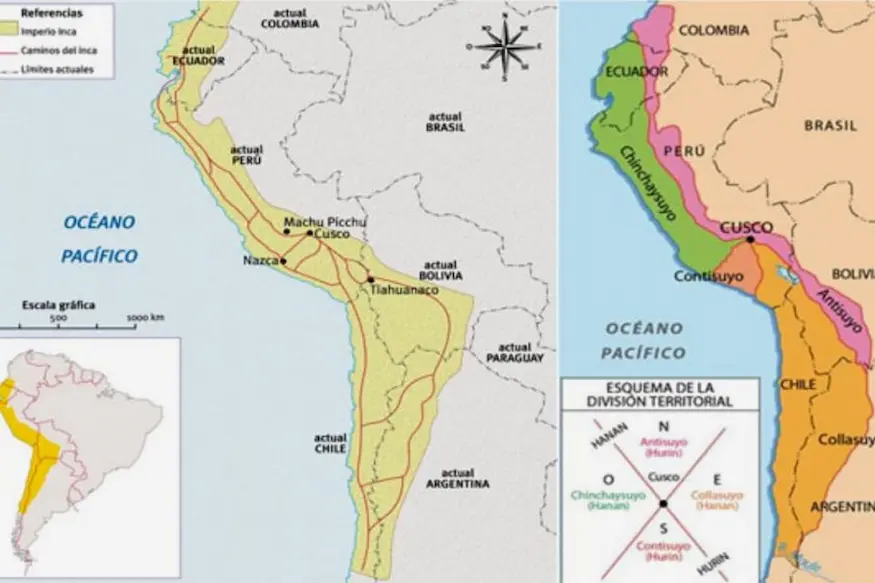
Created the Four Suyus: He divided the empire into Chinchaysuyu, Antisuyu, Contisuyu, and Collasuyu, forming Tawantinsuyu, or “The Four Regions.”
-
Developed a Civil Service: Appointed local administrators (kurakas) to oversee daily life and ensure loyalty.
-
Codified Laws: While the Inca had no writing system, they used quipus (knotted cords) to record taxes, census data, and labor obligations.
These reforms ensured that the growing empire could manage diverse populations, languages, and landscapes under a unified system.
Military Campaigns and Expansion Under Pachacutec
Pachacutec’s reign was marked by a series of successful military conquests. With his trusted generals, including his son Túpac Inca Yupanqui, he expanded the Inca domain dramatically.
Notable Conquests:
-
Lake Titicaca Region: Subjugated the Aymara-speaking peoples.
-
Northern Highlands: Pushed into present-day Ecuador.
-
Southern Andes: Integrated various ethnic groups and highland communities.
-
Sacred Valley: Ensured control over fertile lands near Cusco.
By the end of his reign, Pachacutec had laid the foundation for an empire stretching from modern-day Colombia to northern Chile.
Pachacutec and Machu Picchu
One of the most enduring legacies of Pachacutec is the construction of Machu Picchu, believed to have been built during his rule as a royal estate or ceremonial retreat.
Why Is Machu Picchu Linked to Pachacutec?
-
Architectural Style: The site’s stonework mirrors the high standards of construction in Cusco during his era.
-
Strategic Location: Positioned high in the Andes, it served religious, political, and agricultural functions.
-
Sacred Geography: The site aligns with mountains considered deities (apus) and may have astronomical significance.
Machu Picchu stands today as a symbol of Pachacutec’s vision and Inca ingenuity.
Religion and Cosmology Under Pachacutec
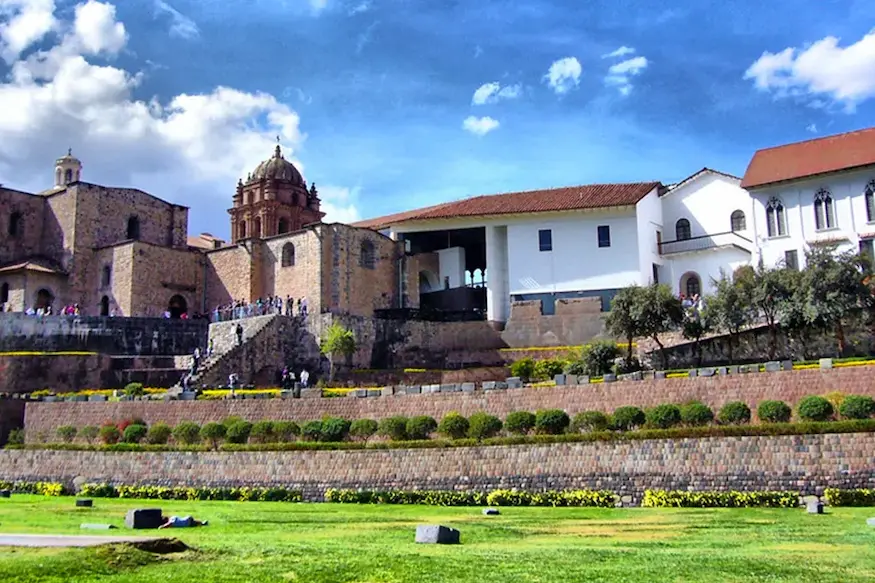
Pachacutec reinforced the Inca religion, centering it around Inti, the sun god. He ordered the construction of the Coricancha (Temple of the Sun) in Cusco, the most sacred temple in the empire.
Religious Reforms:
-
Elevated Inti to supreme deity status.
-
Introduced state-sponsored rituals and festivals like Inti Raymi, the Festival of the Sun.
-
Integrated conquered people’s gods into the Inca pantheon to ensure smoother assimilation.
He understood that spiritual legitimacy was key to maintaining loyalty across diverse cultures.
Engineering Achievements During His Reign
In addition to Machu Picchu, Pachacutec initiated massive infrastructure projects that bound the empire together.
Engineering Marvels:
-
Qhapaq Ñan (Inca Road System): Over 40,000 km of roads to connect the empire.
-
Terracing and Irrigation: Improved agricultural production in difficult terrain.
-
Storehouses (Qollqas): Enabled food redistribution and famine prevention.
His reign exemplifies how engineering and statecraft combined to support Inca supremacy.
Death and Succession
Pachacutec passed away around 1471 CE, after more than three decades of rule. He was succeeded by his son, Túpac Inca Yupanqui, who continued expanding the empire into the north.
Tomb and Legacy:
-
His mummy was preserved and reportedly kept in the Coricancha for centuries.
-
Later Spanish chroniclers described him as the greatest of the Inca emperors.
-
He is honored as the true founder of the Inca Empire, not just a ruler but a cultural architect.
What Made Pachacutec Unique Among Inca Rulers?
Unlike rulers who inherit greatness, Pachacutec built it from scratch. His brilliance lay not just in battle but in envisioning a society governed by laws, faith, and infrastructure.
Traits That Defined Him:
-
Strategic Mindset: Both militarily and politically
-
Religious Reformer: Unified the empire spiritually
-
Builder and Planner: Left tangible monuments
-
Diplomat and Integrator: Respected local customs while ensuring loyalty
These attributes allowed the Inca to thrive under his rule and well beyond.
Pachacutec’s Influence on Modern Peru
To this day, Pachacutec is revered in Peru and across the Andes.
-
Statues of him stand in Cusco and Lima.
-
A major avenue and train to Machu Picchu bear his name.
-
Peruvian schoolbooks teach his legacy as the Inca Empire’s founder.
His story inspires modern leaders, historians, and travelers who visit the lands he once ruled.
Frequently Asked Questions About Pachacutec
Was Pachacutec the first Inca?
No, he was the ninth Sapa Inca, but he is considered the founder of the Inca Empire in its imperial form.
Did Pachacutec build Machu Picchu?
Historians believe he commissioned its construction, but he may not have lived there permanently.
How did he rule such a vast empire without writing?
Through oral tradition, the quipu system, and a highly organized bureaucracy.
What does Pachacutec mean?
It means “Earth Shaker” or “He who overturns time,” symbolizing transformation and power.
Why is he so important in Peruvian culture?
He symbolizes unity, strength, vision, and national pride. His reign is seen as the golden age of the Incas.
Final Thoughts on Pachacutec
The story of Pachacutec is one of extraordinary transformation. He took a vulnerable kingdom and turned it into a sprawling empire, not just through warfare, but through diplomacy, spirituality, architecture, and innovation. From the temples of Cusco to the terraces of Machu Picchu, his fingerprint is embedded in Andean history.
To understand the Inca Empire, one must first understand Pachacutec—the visionary emperor who shook the earth and reshaped the world around him.
Are you ready to live one of the most incredible experiences on the planet?
Machu Picchu is not only a wonder of the world, it is a journey that transforms your soul.
Machu Picchu Tickets, makes your dream of seeing the sacred city of the Incas come true with tours carefully designed for all styles of travelers. Whether you’re looking for an epic hike along the Inca Trail, a scenic train tour or a private getaway, we have the perfect trip for you.
Don’t miss Machu Picchu
Normally booked 60 days in advance.