
Ausangate Trek 4 Days vs 5 Days
Choosing between the Ausangate Trek 4 Days vs 5 Days depends on how much time you have, your hiking experience, your preferred pace, and the specific itinerary offered by your trekking company.
Both options take you into the spectacular high-Andean landscapes surrounding Ausangate Mountain, but they are not simply the same trek with one day removed.
A 4-day itinerary usually follows a shorter route or compresses more hiking into fewer days, while a 5-day itinerary generally provides more time to explore the classic Ausangate circuit.
Here is a quick comparison before looking at the differences in detail.
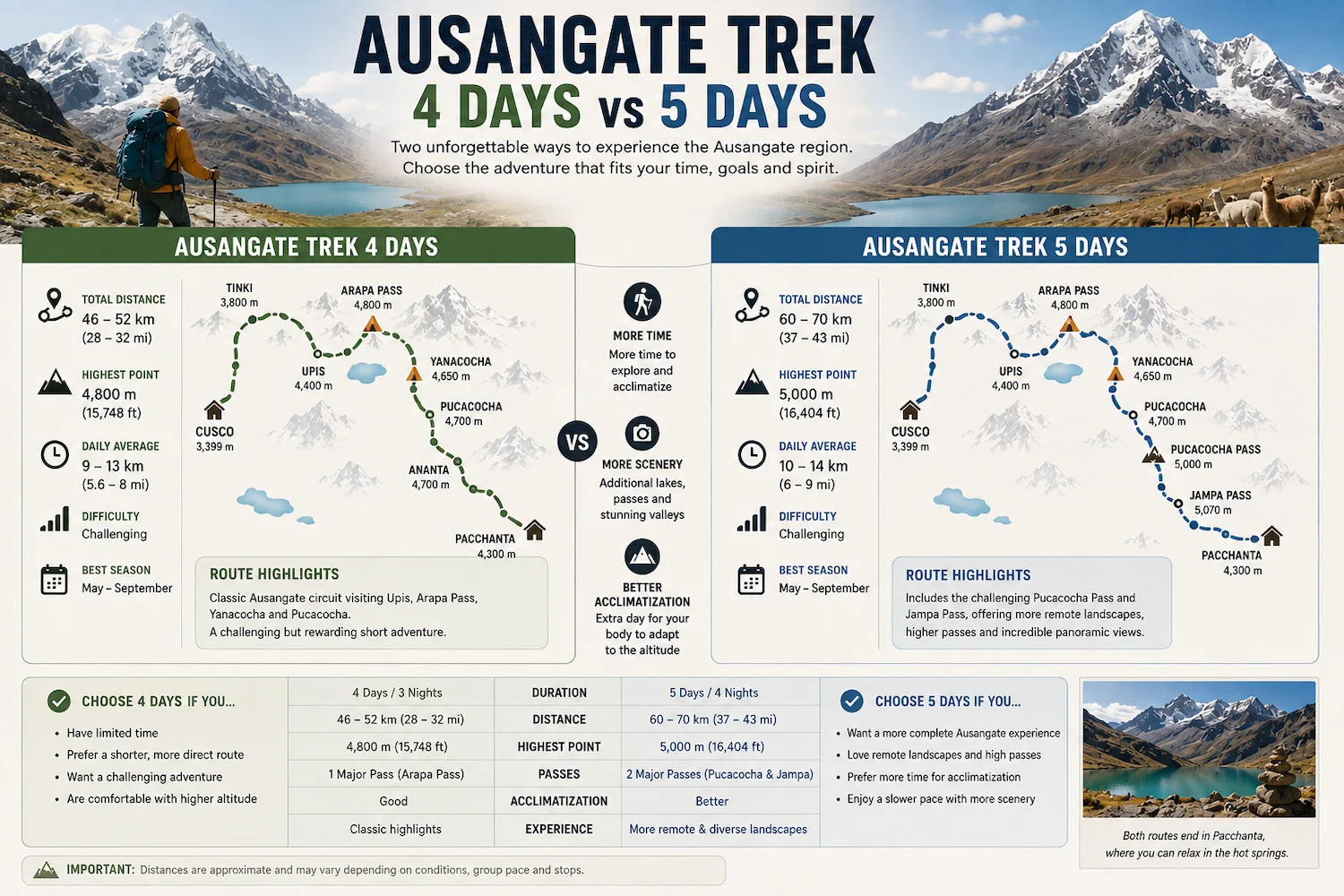
Ausangate Trek 4 Days vs 5 Days: Quick Comparison
| Factor | Ausangate Trek 4 Days | Ausangate Trek 5 Days |
|---|---|---|
| Duration | 4 days | 5 days |
| Approx. distance | 35–55 km | 50–70 km |
| Daily pace | Faster or more compressed | More balanced |
| High-altitude exposure | High | High |
| Mountain passes | Depends on route | Usually more |
| Time for scenery | Less | More |
| Physical demand | Challenging | Challenging |
| Best for | Travelers with limited time | Travelers wanting a fuller experience |
These figures are approximate because there is no single standardized Ausangate itinerary. Starting points, campsites, mountain passes, and optional extensions can all change the route.
Our Ausangate Trek Distance guide explains why distances can vary considerably between different 4- and 5-day itineraries.
What Is the Ausangate Trek 4 Days Like?
The 4-day Ausangate Trek is designed for travelers who want to experience the region but have limited time in Peru.
Depending on the itinerary, it may follow a shorter section of the classic circuit or combine longer hiking sections to complete more terrain within four days.
A typical route can include areas such as:
-
Upis
-
Arapa Pass
-
Pucacocha
-
Ausangate Cocha
-
High mountain passes
-
Pacchanta or another finishing point
However, not every four-day itinerary visits exactly the same places.
The biggest advantage is obvious: you save one day while still experiencing glaciers, colorful lakes, high mountain landscapes, and remote Andean terrain.
The tradeoff is that some itineraries require a faster pace.
What Is the Ausangate Trek 5 Days Like?
The 5-day Ausangate Trek is one of the most common ways to experience the classic circuit.
A typical route may include:
Upis → Arapa Pass → Pucacocha → Ausangate Cocha → Palomani Pass → Jampa/Qampa Pass → Pacchanta
Some classic five-day itineraries cover around 55 km (34 miles) and cross Palomani Pass at approximately 5,200 meters (17,060 feet), although exact distances and campsites vary by operator.
The extra day allows the itinerary to distribute the route differently and generally provides more time in the Ausangate region.
For travelers whose priority is experiencing more of the classic circuit rather than simply completing it quickly, the 5-day option is usually more suitable.
Main Difference: The Route
The most important difference is not simply four days vs five days.
It is the actual route.
Some 4-day itineraries shorten the classic circuit, while others finish at a different location or include Rainbow Mountain.
Five-day itineraries more commonly cover a larger portion of the traditional Ausangate circuit, including several major passes and glacial lakes. Published itineraries vary significantly, which is why comparing the actual route is essential.
Before choosing, look at an Ausangate Trek Map and compare the exact points included in each itinerary.
Which Route Is Longer?
Generally, the 5-day Ausangate Trek is longer.
A 4-day itinerary commonly covers approximately 35–55 km (22–34 mi), while many 5-day routes cover approximately 50–70 km (31–43 mi).
However, these are planning ranges rather than fixed distances.
A shorter route does not automatically mean shorter hiking days.
Some 4-day versions compress considerable distance into fewer days, which can result in longer daily hiking sections.
Which One Is More Difficult?
Both are challenging because they take place at very high altitude.
The 5-day trek may cover more total distance and additional mountain passes, while some 4-day routes can feel demanding because the itinerary is compressed.
The difficulty depends on:
-
Daily hiking distance
-
Elevation gain
-
Maximum altitude
-
Number of mountain passes
-
Campsite elevation
-
Weather
-
Acclimatization
This is why you should compare the specific itinerary rather than assuming 4 days = easier.
Our Ausangate Trek Difficulty guide looks at these factors in more detail.
Altitude: Is There a Difference?
Both routes operate at significant elevation.
Much of the Ausangate region sits above 4,000 meters (13,123 feet), and classic routes can cross passes above 5,000 meters.
For example, Palomani Pass on many classic five-day circuits reaches approximately 5,200 meters (17,060 feet).
Some shortened four-day itineraries avoid certain passes, while others still reach very high elevations.
Therefore, the number of days alone does not tell you the maximum altitude.
Check the Ausangate Trek Altitude and the elevation profile of your specific itinerary before booking.
Daily Hiking Time
A typical Ausangate trekking day can involve approximately 5–8 hours of walking.
On a 4-day route, longer sections may need to be combined depending on the itinerary.
The 5-day route has an additional day available to distribute the distance, although some days can still be long and demanding.
For example, published classic five-day itineraries include individual days of around 6–7.5 hours of hiking, particularly when crossing the major passes.
Do not choose based only on total kilometers.
Compare daily distance + hiking hours + elevation gain.
Scenery and Attractions
Both versions offer spectacular Ausangate scenery.
Depending on the itinerary, you can see:
-
Ausangate Mountain
-
Glaciers
-
Turquoise lakes
-
Alpacas and llamas
-
Remote Andean communities
-
High mountain passes
-
Pucacocha
-
Ausangate Cocha
-
Pacchanta
The 5-day route generally provides more time to explore these landscapes and can include additional sections of the classic circuit.
A 4-day route focuses on completing the selected route within a shorter schedule.
What About Rainbow Mountain?
This depends entirely on the itinerary.
Some Ausangate Trek 4 Days routes finish at Rainbow Mountain, while others follow a more traditional Ausangate route.
The same applies to five-day itineraries: some include Vinicunca and others focus on the classic circuit.
Therefore, do not assume Rainbow Mountain is included simply because you choose four or five days.
Check the itinerary before booking.
Which Is Better for Acclimatization?
Neither itinerary should be used as your initial acclimatization after arriving from sea level.
You should already be reasonably acclimatized before starting Ausangate.
Spending approximately 2–3 days in Cusco or at similar elevation before departure is generally advisable for travelers arriving from low elevations.
Once the trek begins, the five-day itinerary can sometimes provide a more gradual schedule, but this depends on campsite elevations and daily ascents.
Altitude should be considered separately from fitness.
Which Is Better for Beginners?
For beginners, the answer depends more on the specific itinerary than the number of days.
A shorter 4-day route may be appropriate if it avoids some of the most demanding sections.
However, a compressed 4-day route with long hiking days may actually feel harder than a well-paced five-day itinerary.
Beginners should look for:
-
Reasonable daily distances
-
Gradual elevation gain
-
Adequate acclimatization
-
Manageable hiking hours
-
Professional trekking support
If this will be your first high-altitude multi-day trek, our guide on how to prepare for the Ausangate Trek explains how to train before arriving in Peru.
Which Is Better If You Have Limited Time?
Choose the 4-day Ausangate Trek if your Peru itinerary is tight.
Saving one day can be significant if you are also planning to visit Cusco, the Sacred Valley, Machu Picchu, or other destinations.
Just make sure you arrive in Cusco early enough to acclimatize.
Do not save time by removing your acclimatization days.
Which Is Better for the Full Ausangate Experience?
For most travelers interested primarily in Ausangate itself, the 5-day trek provides the more complete experience.
You have additional time to move through the region, and classic five-day routes commonly include major locations such as Pucacocha, Ausangate Cocha, Palomani Pass, Jampa Pass, and Pacchanta.
The extra day also means you are not choosing the route primarily because of a tight schedule.
If you have the time and are comfortable with multi-day high-altitude trekking, five days is generally the better choice for experiencing more of the Ausangate circuit.
4 Days vs 5 Days: Pros and Cons
| 4 Days | 5 Days | |
|---|---|---|
| Pros | Saves time, shorter overall itinerary | More complete route, more time in the mountains |
| Cons | Can be compressed | Requires an extra day |
| Distance | Generally shorter | Generally longer |
| Pace | Can be faster | Usually more balanced |
| Scenery | Excellent | More extensive |
| Best for | Tight schedules | Full trekking experience |
How to Choose Between 4 and 5 Days
Choose the 4-day Ausangate Trek if:
-
You have limited time in Peru
-
You prefer a shorter itinerary
-
The route includes the places you most want to see
-
You are comfortable with potentially longer hiking days
Choose the 5-day Ausangate Trek if:
-
You want to explore more of the classic circuit
-
You have enough time in your itinerary
-
You prefer more time in the mountains
-
You want to cross several major passes
-
You prefer a less compressed schedule
In either case, check the actual itinerary before booking.
What Should You Compare Before Booking?
Do not compare tours based only on price and number of days.
Check:
-
Total distance
-
Daily hiking distance
-
Maximum altitude
-
Campsite elevations
-
Mountain passes
-
Hiking hours
-
Starting point
-
Finishing point
-
Rainbow Mountain inclusion
-
Equipment provided
You should also review the Ausangate Trek Packing List before departure because both routes require proper equipment for cold and changing high-altitude conditions.
Frequently Asked Questions
Is the Ausangate Trek better in 4 or 5 days?
For travelers who have enough time, the 5-day route generally provides a more complete Ausangate experience. Four days is better suited to travelers with limited schedules or those choosing a shorter version of the circuit.
Is the 4-day Ausangate Trek easier?
Not necessarily. Some four-day routes are shorter, but others compress more hiking into fewer days. Compare daily distance and elevation gain before choosing.
How far is the 4-day Ausangate Trek?
Many four-day itineraries cover approximately 35–55 km (22–34 mi), although the exact distance varies by route.
How far is the 5-day Ausangate Trek?
Many five-day itineraries cover approximately 50–70 km (31–43 mi). One published classic route covers 55.5 km (34.48 mi).
Which route has more mountain passes?
Five-day classic circuits generally have more time to cross the major passes around Ausangate, but this depends on the specific itinerary.
Do both routes include Rainbow Mountain?
No. Some 4- and 5-day routes include Rainbow Mountain, while others do not. Always check the itinerary.
Is five days better for altitude?
The extra day can allow the distance to be distributed differently, but both routes remain at very high altitude. Proper acclimatization before departure is essential regardless of which itinerary you choose.
Final Thoughts
When comparing the Ausangate Trek 4 Days vs 5 Days, there is no universal winner.
The 4-day trek makes sense for travelers with limited time who still want to experience Ausangate’s glaciers, lakes, high passes, and remote landscapes.
The 5-day trek is generally better for travelers who want a more complete experience and additional time within the Ausangate circuit.
Most importantly, compare the actual routes.
Two itineraries with the same number of days can have different distances, passes, campsites, and difficulty levels.
Before choosing, review the Ausangate Trek Map, Ausangate Trek Distance, and Ausangate Trek Difficulty to see which itinerary fits your time and trekking experience best.
Related Articles
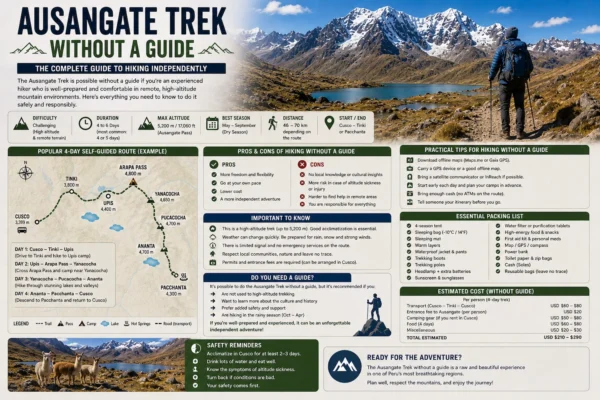
Ausangate Trek Without a Guide
Ausangate Trek Without a Guide Can you do the Ausangate Trek without a guide?…
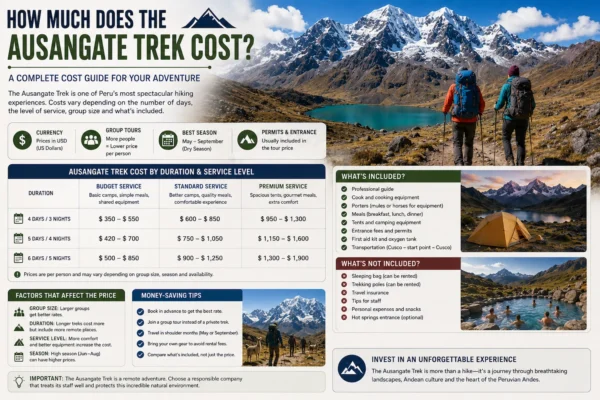
How Much Does the Ausangate Trek Cost?
How Much Does the Ausangate Trek Cost? The Ausangate Trek cost typically ranges from…
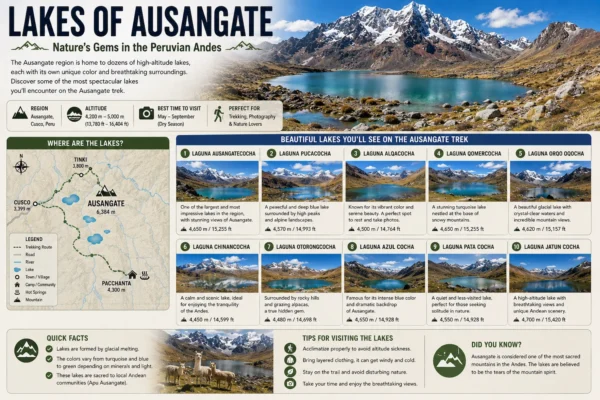
Lakes of Ausangate The Lakes of Ausangate are among the most spectacular natural features…
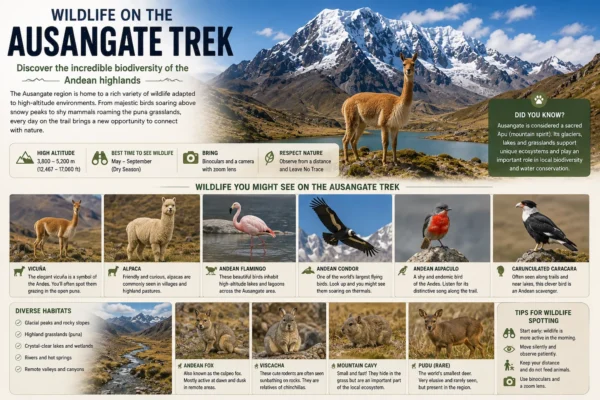
Wildlife on the Ausangate Trek
Wildlife on the Ausangate Trek The wildlife on the Ausangate Trek is adapted to…
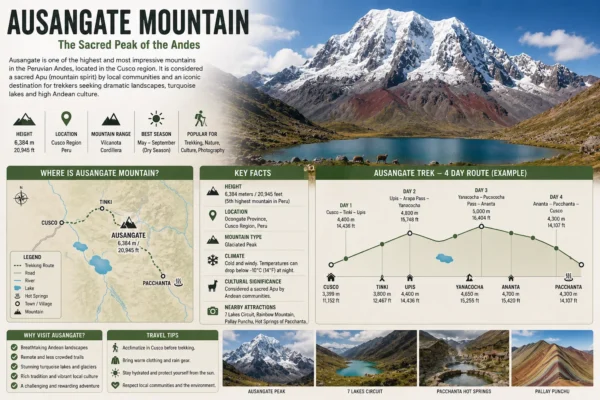
Ausangate Mountain Ausangate Mountain is one of the highest and most important mountains in…
Related Tours