

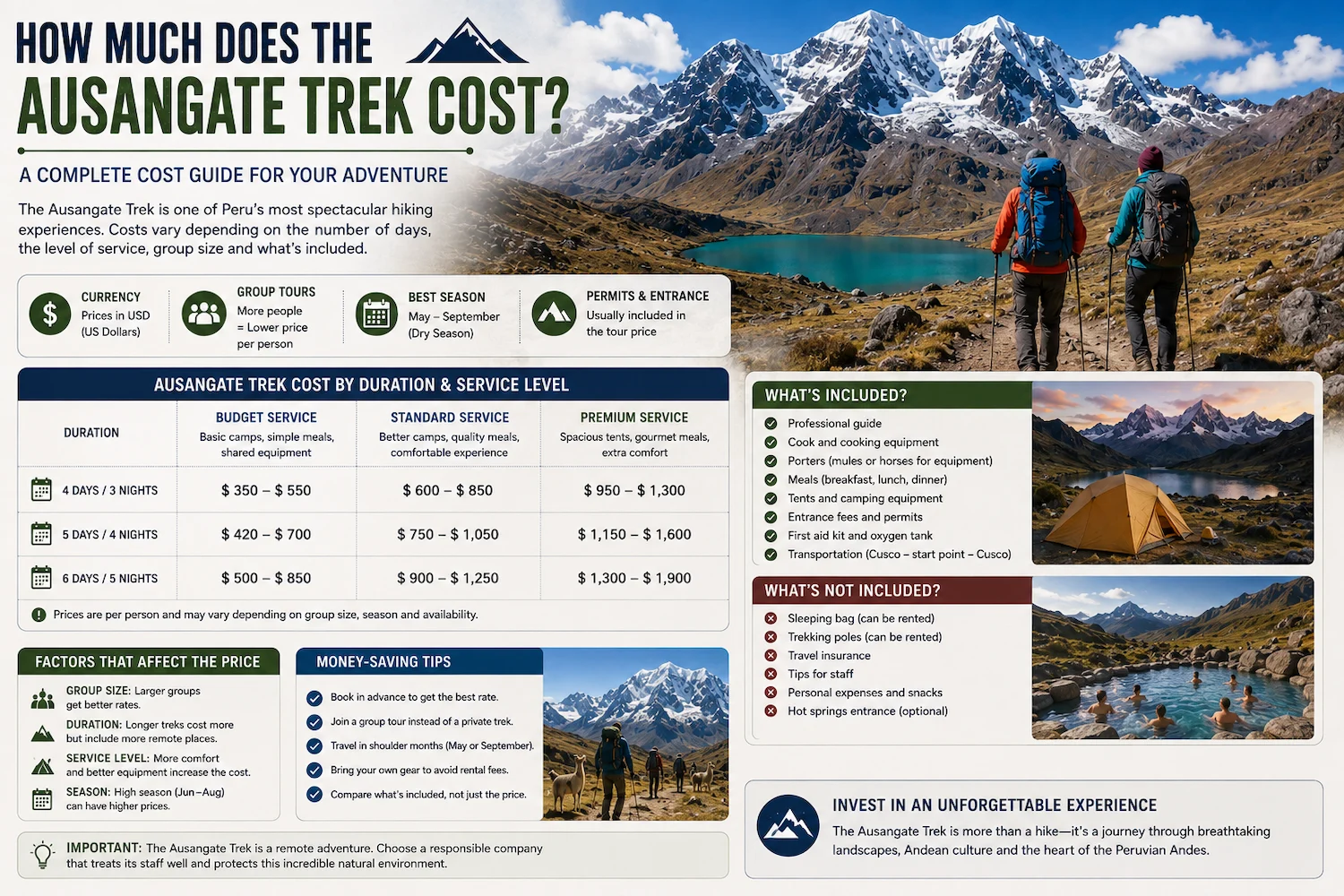
How Much Does the Ausangate Trek Cost?
The Ausangate Trek cost typically ranges from approximately US$450 to US$800+ per person for a guided multi-day trek, depending on the number of days, group size, itinerary, equipment, and level of service.
A standard 4- or 5-day group trek generally costs less than a private departure, while premium services with smaller groups, upgraded camping equipment, additional horses, or extensions such as Rainbow Mountain can cost considerably more.
Unlike the Inca Trail, there is no single standardized Ausangate itinerary or fixed price.
Understanding exactly what is included in the price is therefore more important than simply choosing the cheapest trek.
Average Ausangate Trek Cost
For planning purposes, travelers can expect approximately:
| Ausangate Trek | Typical Planning Range |
|---|---|
| 4 Days | US$450–$650 |
| 5 Days | US$500–$700 |
| 6 Days | US$550–$800+ |
| Private Trek | US$700–$1,200+ |
| Premium/Luxury Trek | US$1,000+ |
These are general planning ranges, not fixed prices.
Current published examples show 4-day departures around US$500–550 and several classic 5-day options around US$550–680 per person.
Prices can increase or decrease depending on group size and exactly what the operator includes.
How Much Does the 4-Day Ausangate Trek Cost?
A 4-day Ausangate Trek commonly costs approximately US$450–$650 per person for a standard guided service.
For example, currently published four-day itineraries can be found around US$500–550 per person, although private services may cost more.
A typical price may include:
-
Professional trekking guide
-
Transportation from Cusco
-
Camping equipment
-
Meals during the trek
-
Cook
-
Horses for group equipment
-
Basic emergency equipment
However, inclusions vary between companies.
A lower price may exclude sleeping bags, trekking poles, community entrance fees, personal horses, or other services.
How Much Does the 5-Day Ausangate Trek Cost?
The 5-day Ausangate Trek generally costs around US$500–$700 per person for a standard group departure.
Current published prices include examples around:
US$550 → US$600 → US$620 → US$650+
depending on the trekking company and services included.
Five days is one of the most common ways to complete the classic Ausangate circuit.
Because it involves an additional day of meals, camping, guide services, horses, and trekking staff, it will often cost slightly more than a comparable four-day service.
If you are deciding whether that extra day is worthwhile, see our Ausangate Trek 4 Days vs 5 Days comparison.
How Much Does the 6-Day Ausangate Trek Cost?
A 6-day Ausangate Trek can cost approximately US$550–$800+ per person, depending heavily on the route.
Longer itineraries may include:
-
More of the classic circuit
-
Additional lakes
-
Extra mountain passes
-
Rainbow Mountain
-
Additional camps
-
More meals
-
Additional staff time
One currently published six-day Ausangate and Rainbow Mountain itinerary, for example, lists a price of US$600 per person.
Private or premium six-day departures can cost substantially more.
Why Does the Ausangate Trek Cost So Much?
Ausangate takes place in a remote mountain environment.
A trekking company must transport almost everything required for several days in the Andes.
Your trek price may therefore support an entire trekking team rather than simply paying for a guide.
Depending on the operation, this can include:
-
Guide
-
Cook
-
Horsemen
-
Horses or mules
-
Camping equipment
-
Food
-
Transportation
-
Emergency equipment
-
Logistics
The longer the itinerary, the more resources are required.
This is one reason comparing a multi-day Ausangate Trek with the price of a normal one-day tour around Cusco is not particularly useful.
What Is Usually Included?
A standard guided Ausangate Trek commonly includes many of the major logistical expenses.
Transportation
Transportation from Cusco to the trailhead and transportation back to Cusco at the end of the trek are commonly included.
Professional Guide
A trekking guide accompanies the group throughout the route.
Meals
Most organized treks provide:
-
Breakfast
-
Lunch
-
Dinner
-
Snacks or tea
The exact meal plan depends on the itinerary.
Cook
Multi-day trekking groups commonly travel with a cook who prepares meals at camp.
Camping Equipment
Operators generally provide shared camping equipment such as:
-
Tents
-
Dining tent
-
Kitchen equipment
-
Tables and chairs
Sleeping bags may or may not be included.
Pack Animals
Horses are commonly used to transport camping equipment, food, and other group supplies.
Some operators also allow trekkers to send a limited amount of personal luggage with the horses.
Always check the weight allowance.
What Is Usually Not Included?
Several expenses may need to be paid separately.
Common exclusions include:
-
International flights
-
Hotels in Cusco
-
Travel insurance
-
Personal hiking equipment
-
Sleeping bag rental
-
Trekking pole rental
-
Additional horse
-
Tips
-
Personal snacks
-
Alcoholic drinks
-
Some entrance fees
-
Hot spring fees
-
Rainbow Mountain entrance
The exact exclusions vary considerably between trekking companies.
Always read the inclusion list before comparing prices.
Group vs Private Ausangate Trek Cost
One of the biggest factors affecting price is whether you join a group or book a private departure.
| Service | Typical Cost | Best For |
|---|---|---|
| Group Trek | US$450–$700 | Most travelers |
| Small Group | US$550–$800+ | More personalized experience |
| Private Trek | US$700–$1,200+ | Couples, families, private groups |
| Premium Trek | US$1,000+ | Higher comfort |
Group departures allow transportation, guides, cooks, and logistical costs to be divided among several travelers.
Private departures distribute those costs among fewer people.
This is why the price per person can be considerably higher.
Does Group Size Affect the Price?
Yes.
A private trek for two people will usually cost more per person than a private trek for six people.
The trekking company still needs to organize:
-
Transportation
-
Guide
-
Cook
-
Horses
-
Equipment
-
Food
-
Logistics
With a larger group, some of these expenses can be shared.
This is also why some operators advertise different prices according to the number of travelers.
Cheap Ausangate Treks: What Should You Check?
Finding a low price is not automatically a problem.
However, if one trek is dramatically cheaper than similar itineraries, check what has been removed from the service.
Ask:
-
Is transportation included?
-
Are all meals included?
-
Is there a professional guide?
-
Is a cook included?
-
Are tents included?
-
Are horses included?
-
How much luggage can the horse carry?
-
Are entrance fees included?
-
Is emergency oxygen available?
-
What happens during an emergency?
A difference of US$100–200 can sometimes reflect meaningful differences in equipment, staff, group size, or inclusions.
Ausangate Trek Cost vs Distance
Longer routes generally cost more because they require additional days of logistics.
However, distance alone does not determine the price.
A four-day itinerary can sometimes cost more than a five-day itinerary if it provides:
-
Smaller groups
-
Better camping equipment
-
Private transportation
-
Additional horses
-
More experienced staff
-
Premium meals
Our Ausangate Trek Distance guide explains how the routes differ between four, five, and six days.
Does Rainbow Mountain Increase the Cost?
Sometimes.
There are Ausangate itineraries that finish at or incorporate Rainbow Mountain (Vinicunca).
These routes can involve different transportation, campsites, distances, and entrance fees.
For example, currently published Ausangate itineraries combining the region with Rainbow Mountain range from approximately US$500 for four days to around US$600 for longer versions, although operators and services vary.
Always check whether Vinicunca is actually included rather than assuming every Ausangate Trek visits Rainbow Mountain.
Entrance Fees
Unlike the Classic Inca Trail, Ausangate does not operate under the same limited government permit system.
However, local communities along trekking routes may charge entrance or access fees.
Rainbow Mountain also has its own local entrance arrangements when included in an itinerary.
Some trekking companies include these costs in the tour price, while others require travelers to carry Peruvian soles and pay locally.
Check this before departure.
Sleeping Bag Rental
A sleeping bag is not always included in the base trek price.
If you do not want to travel to Peru carrying one, many trekking companies provide rentals.
Make sure the sleeping bag is appropriate for cold high-altitude camping.
Ausangate camps can become extremely cold at night.
Before renting or buying equipment, review our Ausangate Trek Packing List.
Trekking Pole Rental
Trekking poles may also be available for an additional fee.
They are particularly useful on:
-
Long descents
-
Steep climbs
-
Rocky trails
-
Muddy terrain
If you already own lightweight trekking poles and have luggage space, bringing your own can eliminate this expense.
Extra Horse Cost
Many organized treks already include horses for group equipment and a limited amount of personal luggage.
However, travelers sometimes request an additional emergency or riding horse.
This normally costs extra.
If you are concerned about completing the route physically, ask your operator beforehand whether riding horses are available and how much they cost.
Do not assume one will automatically be available when you need it.
Tips for Guides, Cooks, and Horsemen
Tips are generally not included in the advertised trek price.
They are optional and should reflect the quality of service you receive.
Because an Ausangate Trek can involve several staff members, travelers who plan to tip should include some additional cash in their overall budget.
Peruvian soles are generally more practical for local payments during the trek.
How Much Cash Should You Bring?
Even if your trek has been prepaid, carrying some Peruvian soles is useful.
You may need cash for:
-
Community fees
-
Hot springs
-
Drinks
-
Snacks
-
Small purchases
-
Tips
-
Toilets
-
Optional services
ATMs are not available once you are deep into the Ausangate circuit.
Bring the cash you expect to need before leaving Cusco.
Is a More Expensive Ausangate Trek Better?
Not automatically.
Price alone does not guarantee quality.
Instead, compare what you actually receive.
Look at:
Price + itinerary + group size + equipment + guide + meals + horses + emergency support
A US$550 trek with excellent logistics may provide better value than a US$750 trek with similar services.
Likewise, an extremely inexpensive trek may become more expensive once rentals, fees, and other extras are added.
Can You Hike Ausangate Without a Tour?
Experienced trekkers can travel independently in parts of the Ausangate region.
Doing so can reduce the direct cost of guides and organized services.
However, you then become responsible for:
-
Navigation
-
Transportation
-
Food
-
Camping equipment
-
Cooking
-
Emergency planning
-
Weather decisions
-
Community fees
-
High-altitude safety
Ausangate crosses remote terrain at extreme elevation.
Independent trekking should therefore be considered primarily by travelers with appropriate backcountry and high-altitude experience.
The Ausangate Trek Map can help you understand how remote the main circuit is.
Is the Ausangate Trek Worth the Cost?
For travelers who enjoy remote mountain trekking, Ausangate offers a very different experience from Peru’s more developed tourist routes.
A multi-day itinerary can include:
-
Glaciers
-
Turquoise lakes
-
High mountain passes
-
Alpaca herds
-
Remote communities
-
Hot springs
-
High-Andean wildlife
The experience is not centered around one archaeological attraction.
Instead, you are paying for several days of supported travel through remote mountain terrain.
For many trekkers, that combination makes Ausangate one of the most rewarding multi-day routes around Cusco.
How to Choose an Ausangate Trek
Do not choose based on price alone.
Compare at least:
-
Exact itinerary
-
Total distance
-
Maximum altitude
-
Daily hiking hours
-
Group size
-
Camping equipment
-
Meals
-
Personal luggage allowance
-
Emergency equipment
-
Included and excluded expenses
The cheapest trek can become poor value if you need to pay separately for several essential services.
Likewise, the most expensive option is unnecessary if the additional services do not matter to you.
Budget for the Ausangate Trek
A traveler planning a standard guided trek could budget approximately:
| Expense | Planning Budget |
|---|---|
| Trek | US$450–$800 |
| Equipment rentals | US$20–$80 |
| Entrance/local fees | US$10–$50+ |
| Tips | Personal choice |
| Snacks/drinks | US$10–$30 |
| Travel insurance | Varies |
| Hotel before/after trek | Varies |
This means your total Ausangate budget should be slightly higher than the advertised tour price.
Leave some room for optional expenses and services.
Frequently Asked Questions
How much does the Ausangate Trek cost?
A guided Ausangate Trek generally costs approximately US$450–$800+ per person, depending on duration, group size, itinerary, and service level.
How much is the 4-day Ausangate Trek?
A standard four-day guided trek commonly costs around US$450–$650 per person.
How much is the 5-day Ausangate Trek?
Many five-day group treks currently fall around US$500–$700 per person, with several published options around US$550–650.
Is Ausangate cheaper than the Inca Trail?
It often can be, particularly because Ausangate does not use the same limited permit system as the Classic Inca Trail. However, prices depend on the operator, duration, and level of service.
Are meals included?
Most organized multi-day treks include meals during the hiking portion, but always confirm exactly which breakfasts, lunches, and dinners are provided.
Are horses included?
Pack horses for camping equipment are commonly included in organized treks. Personal luggage allowances and riding horses vary by operator.
Do I need to pay entrance fees?
Possibly. Local communities may charge access fees, and additional attractions such as Rainbow Mountain can have separate entrance costs. Check whether these are included in your package.
Is a private Ausangate Trek expensive?
Private departures generally cost more because transportation, guides, cooks, and logistics are shared among fewer travelers. Expect private services to cost significantly more than standard group departures.
Should I choose the cheapest Ausangate Trek?
Not based on price alone. Compare the guide, group size, camping equipment, meals, horses, emergency support, transportation, and entrance fees before deciding.
Final Thoughts
So, how much does the Ausangate Trek cost?
For most travelers, a realistic starting budget is approximately US$450–$800+ per person for a guided multi-day trek.
Four-day routes generally sit toward the lower end of that range, while longer, private, or premium itineraries can cost considerably more.
The advertised price is only part of the comparison.
Before booking, check exactly what is included and consider additional expenses such as equipment rental, local entrance fees, optional horses, tips, and personal purchases.
Most importantly, choose your itinerary first and compare prices second.
Use our Ausangate Trek 4 Days vs 5 Days guide to choose the appropriate duration, then review the Ausangate Trek Difficulty and Ausangate Trek Packing List before heading into the mountains.
Related Articles
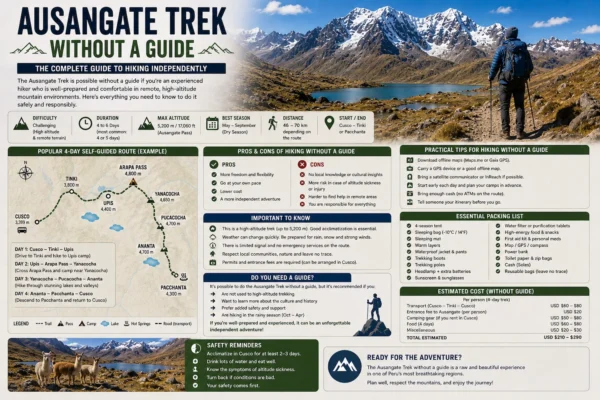
Ausangate Trek Without a Guide
Ausangate Trek Without a Guide Can you do the Ausangate Trek without a guide?…
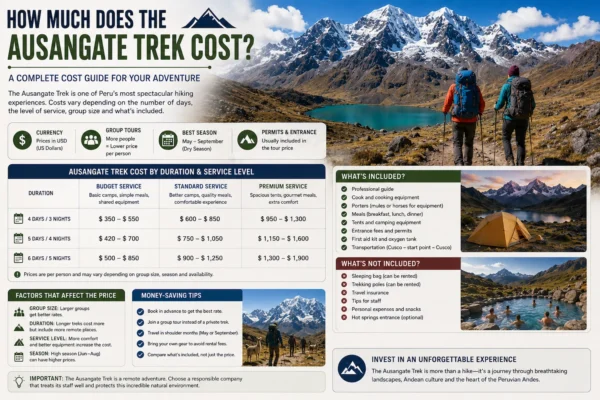
How Much Does the Ausangate Trek Cost?
How Much Does the Ausangate Trek Cost? The Ausangate Trek cost typically ranges from…
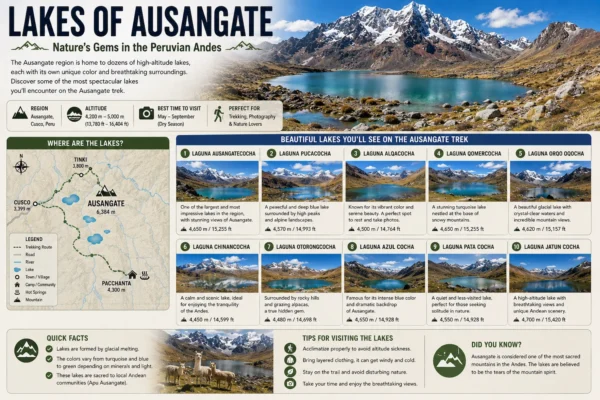
Lakes of Ausangate The Lakes of Ausangate are among the most spectacular natural features…
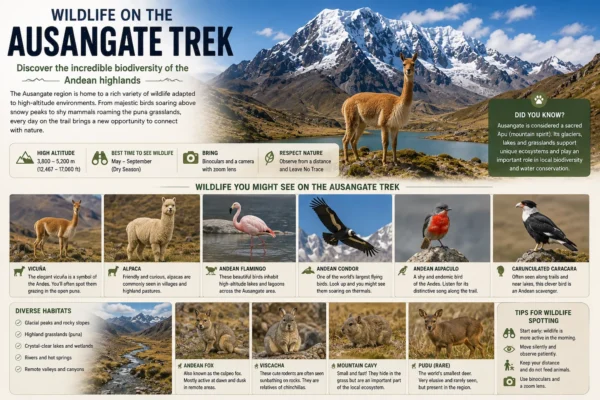
Wildlife on the Ausangate Trek
Wildlife on the Ausangate Trek The wildlife on the Ausangate Trek is adapted to…
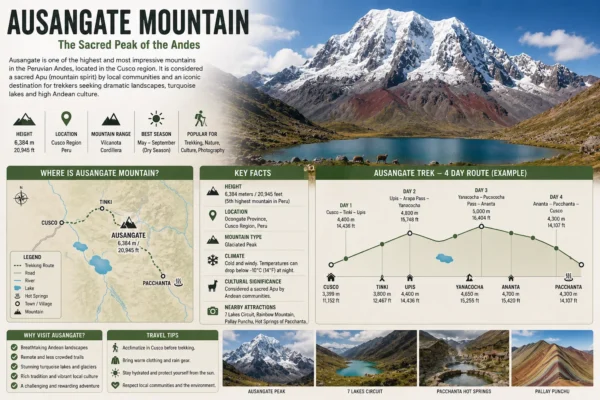
Ausangate Mountain Ausangate Mountain is one of the highest and most important mountains in…
Related Tours