
Ausangate Trek Without a Guide
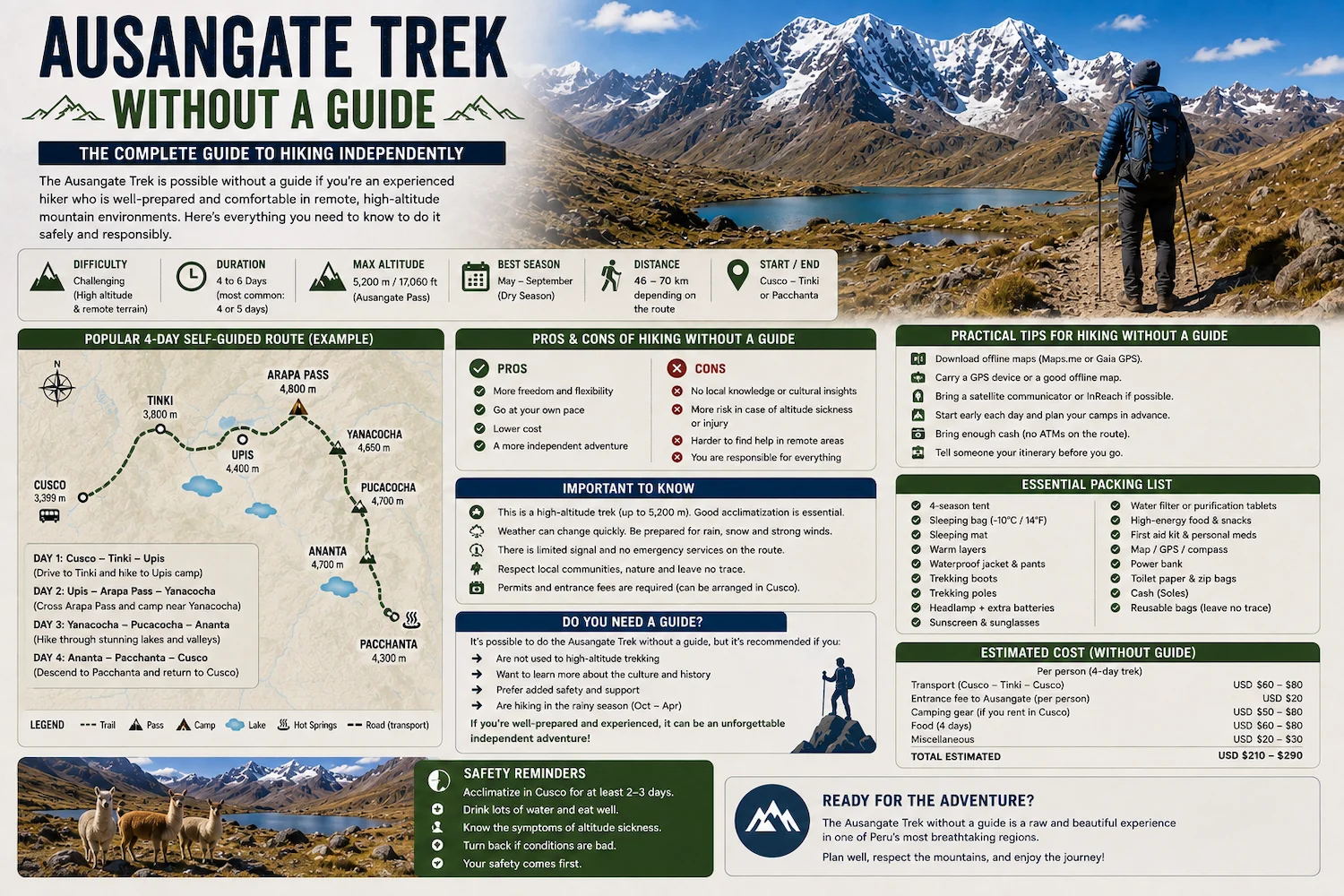
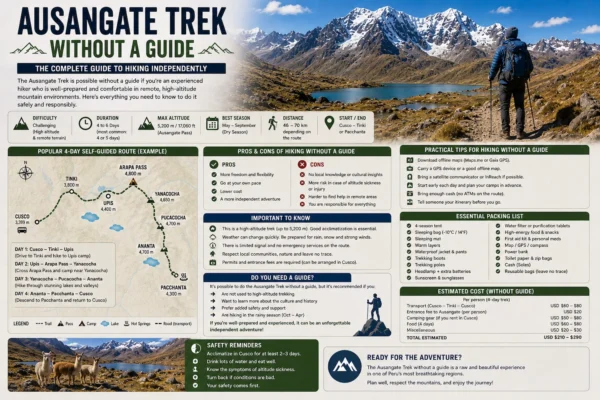
Can you do the Ausangate Trek without a guide?
Yes. Unlike the Classic Inca Trail, the Ausangate Trek does not require travelers to join an authorized guided tour, and experienced hikers can complete the route independently.
However, being allowed to hike Ausangate without a guide does not mean it is the right choice for everyone.
The route crosses remote terrain at elevations above 4,000 meters (13,123 feet), with some mountain passes exceeding 5,000 meters (16,404 feet). Trail markings can also be limited, weather changes quickly, and communication is difficult in remote sections.
For experienced backpackers comfortable with high-altitude camping, navigation, cold weather, and carrying their own equipment, independent trekking is possible.
For most travelers, a guided trek is the simpler and safer option.
Do You Need a Guide for the Ausangate Trek?
No. A guide is not legally required to hike the Ausangate Trek.
This is one of the major differences between Ausangate and the Classic Inca Trail.
The Inca Trail operates under a regulated permit system, while Ausangate crosses a broader network of trails and community lands around the Vilcanota mountain range.
Independent travelers can therefore organize their own:
-
Transportation
-
Route
-
Camping
-
Food
-
Equipment
-
Navigation
However, local communities may collect entrance, camping, or access fees along the route.
Carry Peruvian soles in small denominations because electronic payment should not be expected in remote areas.
Is the Ausangate Trek Easy to Navigate?
Not always.
There are recognizable trails throughout much of the region, but you should not expect continuous signs pointing toward the next campsite.
The landscape also contains:
-
Livestock trails
-
Trail intersections
-
Open grasslands
-
Rocky sections
-
Remote valleys
-
Multiple possible routes
Some paths can appear equally established because they are regularly used by local communities and grazing animals.
Weather can make navigation even more difficult.
Clouds, rain, hail, or snow can reduce visibility around the highest sections of the route.
If hiking independently, you should have a reliable offline GPS route rather than depending only on visible trails.
Our Ausangate Trek Map can help you understand the main geographical points before planning your route.
Can You Hike Ausangate Solo?
Technically, yes.
But hiking solo and hiking without a guide are not necessarily the same decision.
Two experienced hikers traveling independently have an additional layer of support if something goes wrong.
A solo traveler does not.
Potential problems include:
-
Getting lost
-
Altitude sickness
-
Injury
-
Severe weather
-
Equipment failure
-
Hypothermia
-
Inability to continue hiking
Because sections of Ausangate are remote, you cannot assume another trekking group will quickly appear.
Solo hikers should therefore have substantial experience with remote multi-day trekking before considering the route.
Who Should Consider Hiking Without a Guide?
Independent Ausangate trekking is most appropriate for travelers who already have experience with:
-
Multi-day backpacking
-
High-altitude hiking
-
Camping below freezing
-
GPS navigation
-
Route finding
-
Water purification
-
Cooking in the backcountry
-
Carrying camping equipment
-
Emergency planning
-
Rapidly changing mountain weather
Having completed several normal day hikes is not equivalent preparation.
Ausangate is a remote high-altitude backpacking route.
If this would be your first multi-day camping trek, joining a guided departure is generally the better choice.
Who Should Hire a Guide?
A guided trek makes more sense if:
-
This is your first multi-day trek
-
You have limited high-altitude experience
-
You are uncomfortable navigating independently
-
You do not own appropriate camping equipment
-
You do not want to carry substantial weight
-
You are traveling alone
-
You prefer organized transportation
-
You want meals prepared
-
You want local knowledge along the route
A guide also allows you to concentrate more on hiking rather than constantly managing navigation and logistics.
Guided vs Independent Ausangate Trek
| Factor | Without Guide | Guided Trek |
|---|---|---|
| Navigation | Your responsibility | Guide handles route |
| Camping equipment | Carry/organize yourself | Usually provided |
| Food | Carry and cook yourself | Usually provided |
| Transportation | Organize yourself | Usually included |
| Pack animals | Arrange separately | Commonly included |
| Local knowledge | Limited | Guide provides context |
| Emergency planning | Your responsibility | Trekking team support |
| Flexibility | Very high | Follows itinerary |
| Cost | Lower | Higher |
| Physical load | Potentially much higher | Usually lighter |
| Best for | Experienced backpackers | Most travelers |
The major advantage of independent trekking is freedom.
The major advantage of guided trekking is logistical support.
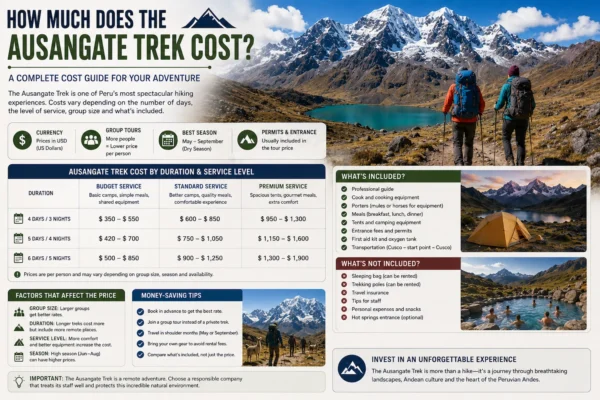
How Much Cheaper Is Ausangate Without a Guide?
Independent trekking can be significantly cheaper because you are not paying for a complete trekking team.
However, “without a guide” does not mean “free.”
You still need to consider:
-
Transportation
-
Food
-
Fuel
-
Camping equipment
-
Community fees
-
Accommodation before/after
-
Emergency equipment
-
Equipment rental
-
Possible horse rental
If you already own all your backpacking equipment, the savings can be considerable.
If you need to rent most of your gear in Cusco, the difference becomes smaller.
Our guide to How Much Does the Ausangate Trek Cost? compares typical guided trekking costs and additional expenses.
Do You Need a Permit for Ausangate?
There is currently no government trekking permit equivalent to the Classic Inca Trail permit for the standard Ausangate circuit.
However, this does not mean every section is free.
The route crosses land managed by different local communities.
Travelers may encounter local entrance or camping fees at several points.
The amount and collection points can change, so independent hikers should confirm current arrangements locally before departure.
Carry cash.
Once you leave the larger towns, you should not expect ATMs or reliable card payments.
Where Does the Independent Trek Start?
Tinki (Tinqui) is the traditional gateway to the Ausangate region.
From there, trekkers can continue toward different trailheads.
Many modern itineraries begin closer to:
-
Upis
-
Pacchanta
-
Nearby rural trailheads
Using local transportation to reach a trailhead can reduce the amount of walking on roads or agricultural tracks.
Your exact starting point will significantly affect your total distance.
This is one reason published Ausangate Trek Distance figures can differ so much between itineraries.
Where Can You Camp?
There are established camping areas along commonly used Ausangate routes.
Popular camping zones can include areas around:
-
Upis
-
Pucacocha
-
Ausangate Cocha
-
Sorapata/Soraycucho
-
Jampa/Qampa
-
Pacchanta
The exact campsites depend on the circuit you follow.
Some camping areas are associated with local communities and may require payment.
Independent trekkers should not assume they can camp anywhere simply because the landscape appears empty.
Respect local land, livestock, homes, and community instructions.
Do You Need to Carry Your Own Tent?
If hiking completely independently, yes—you should be prepared to carry your own shelter.
Your camping setup needs to handle:
-
Strong wind
-
Rain
-
Snow
-
Hail
-
Freezing temperatures
This is not the place to test an unfamiliar tent for the first time.
Use equipment you already know how to set up quickly, including in poor weather.
How Cold Is Camping on Ausangate?
Very cold.
Campsites frequently sit above 4,000 meters, and nighttime temperatures can fall below freezing.
Conditions vary by month and campsite elevation.
Cold becomes particularly important for independent hikers because there is no trekking company responsible for providing appropriate sleeping equipment.
Your sleeping system should include an adequately rated:
sleeping bag + insulated sleeping mat + weather-resistant tent
Do not evaluate your sleeping bag based only on daytime temperatures in Cusco.
Conditions on the Ausangate circuit are considerably colder.
Navigation Equipment
A phone with an offline map can be useful, but relying on a single device creates unnecessary risk.
Independent hikers should consider carrying:
-
Offline GPS route
-
Smartphone navigation
-
Power bank
-
Charging cable
-
Backup navigation method
-
Paper map if comfortable using one
Download everything before leaving Cusco.
Do not assume you will have mobile data on the trail.
Is There Cell Phone Service?
You should plan as though reliable cell service will not be available across the remote sections of the trek.
This changes how you should approach emergencies.
A problem that would be relatively minor near Cusco can become much more serious several hours from the nearest road.
Experienced independent trekkers may consider carrying a satellite communication device for emergency situations.
Water on the Ausangate Trek
There are streams, lakes, and other water sources throughout the mountain environment, but natural water should not automatically be considered safe to drink.
Livestock are common throughout the region.
Alpacas, llamas, sheep, horses, and other animals can contaminate water sources.
Independent hikers should carry an appropriate method of water treatment, such as:
-
Water filter
-
Purification tablets
-
Other reliable purification system
Always evaluate your next water source before leaving camp.
Food and Cooking
Independent trekkers must carry enough food for the complete route plus a reasonable emergency reserve.
Choose food that is:
-
Lightweight
-
Calorie-dense
-
Easy to prepare
-
Familiar to your stomach
Remember that cooking takes place at high altitude and potentially in freezing or windy conditions.
Your cooking system must therefore be appropriate for mountain use.
Do not depend on buying meals along the route.
Small communities exist throughout the region, but services are limited and should not be treated like established trekking lodges.
How Much Weight Will You Carry?
This is one of the biggest differences between guided and independent trekking.
On an organized Ausangate Trek, horses typically transport:
-
Tents
-
Food
-
Cooking equipment
-
Group equipment
-
Part of your personal luggage
Without this support, you may need to carry everything yourself.
That can mean a significantly heavier backpack.
Carrying 15 kg at sea level is one thing.
Carrying the same weight while climbing toward 5,000 meters is completely different.
The Ausangate Trek altitude should therefore be considered when deciding whether you actually want to trek independently.
Can You Hire a Horse Without Booking a Tour?
It may be possible to arrange horses and local horsemen in communities around the Ausangate region.
However, availability should not be assumed.
If you plan to depend on pack animals, organize them before beginning the route rather than hoping to find one along the trail.
You will also need to communicate clearly about:
-
Price
-
Route
-
Number of days
-
Weight
-
Campsites
-
Finishing point
Spanish is useful, and Quechua is widely spoken in communities around Ausangate.
Altitude Is the Biggest Challenge
Navigation receives a lot of attention when discussing independent trekking, but altitude may be the more significant challenge.
Much of the circuit remains above 4,000 meters, while major passes can exceed 5,000 meters.
At these elevations, you may experience:
-
Headache
-
Fatigue
-
Shortness of breath
-
Reduced appetite
-
Difficulty sleeping
More serious altitude illness can become an emergency.
Being physically fit does not make you immune.
Independent trekkers must be capable of recognizing when continuing upward is unsafe.
Acclimatize Before Starting
Do not arrive in Cusco and immediately begin the Ausangate circuit.
Travelers arriving from low elevation should spend several days acclimatizing before attempting the trek.
Use that time to:
-
Rest
-
Walk around Cusco
-
Complete moderate hikes
-
Test equipment
-
Organize food
-
Confirm transportation
-
Check weather conditions
Our guide on How to Prepare for the Ausangate Trek explains physical preparation and acclimatization in more detail.
Weather Without a Guide
When traveling independently, you make the weather decisions.
There is no guide deciding whether it is appropriate to cross the next mountain pass.
Ausangate can experience:
-
Strong sun
-
Wind
-
Rain
-
Hail
-
Snow
-
Freezing temperatures
-
Rapidly developing clouds
Conditions around a high pass can be very different from conditions at camp.
Check the Best Time to Hike the Ausangate Trek before choosing your travel dates.
What Equipment Do You Need?
Independent trekkers need more equipment than travelers joining an organized trek.
At minimum, consider:
Camping
-
Mountain-appropriate tent
-
Cold-weather sleeping bag
-
Insulated sleeping mat
Clothing
-
Base layers
-
Insulating layers
-
Waterproof shell
-
Warm jacket
-
Gloves
-
Warm hat
Navigation
-
Offline GPS
-
Power bank
-
Backup navigation
Food and Water
-
Stove
-
Fuel
-
Food
-
Water bottles
-
Water purification
Safety
-
First-aid kit
-
Emergency communication
-
Headlamp
-
Emergency food
See our complete Ausangate Trek Packing List before organizing your equipment.
Is Ausangate Well Marked?
Not consistently enough that an inexperienced traveler should rely entirely on signs.
Some sections are obvious.
Others pass through open mountain terrain where multiple paths exist.
Livestock trails can also look like trekking routes.
GPS navigation and route-finding experience are therefore highly recommended for independent trekkers.
Do not assume:
“I’ll just follow other hikers.”
Ausangate is significantly quieter than Peru’s busiest trekking routes.
What Happens in an Emergency?
This is one of the strongest arguments for considering a guide.
Ausangate is remote.
An injury, severe altitude problem, or navigation mistake can occur far from vehicle access.
Independent trekkers should have an emergency plan that answers:
-
How will I communicate?
-
Where is the nearest road?
-
Can I navigate back?
-
What happens if I cannot walk?
-
Does someone know my itinerary?
-
When should they expect me back?
-
What insurance coverage do I have?
Leave your planned route and expected return date with someone before departing.
Independent Trekking During the Rainy Season
Independent trekking becomes more complicated when weather deteriorates.
Rain and snow can:
-
Hide trails
-
Reduce visibility
-
Make slopes slippery
-
Increase stream flow
-
Create muddy sections
-
Make camping colder
For experienced backpackers, these conditions require additional judgment and equipment.
For inexperienced hikers, they significantly increase the reasons to travel with professional support.
Is Ausangate Without a Guide Worth It?
For the right person, absolutely.
Experienced backpackers may appreciate the independence, quiet camps, flexible schedule, and ability to explore the mountains at their own pace.
But the advantages come with responsibility.
You become your own:
navigator + cook + porter + logistics coordinator + safety manager.
For some trekkers, that independence is exactly the appeal.
For others, carrying less equipment and having meals, navigation, transportation, and logistics handled by a trekking team creates a much better experience.
Frequently Asked Questions
Can you do the Ausangate Trek without a guide?
Yes. A guide is not legally required for the standard Ausangate Trek, and experienced backpackers can complete the route independently.
Do you need a permit to hike Ausangate independently?
There is no government permit system equivalent to the Classic Inca Trail. However, local communities may charge access and camping fees along the route.
Is Ausangate safe without a guide?
It can be completed independently by experienced, properly equipped high-altitude backpackers. The primary risks include altitude, cold weather, navigation problems, remoteness, and limited emergency assistance.
Is the Ausangate Trek well marked?
Some sections are relatively obvious, while others have limited signage or multiple paths. Independent hikers should carry reliable offline navigation.
Can you camp independently?
Camping is possible along the route, but some areas are managed by local communities and may require payment. Always respect local instructions and private/community land.
Can you hike Ausangate solo?
Yes, but solo trekking adds additional risk because there is no companion available during an emergency. It is most appropriate for highly experienced backpackers.
Is there phone signal on the Ausangate Trek?
Reliable mobile coverage should not be expected throughout the remote sections of the circuit.
Can beginners hike Ausangate without a guide?
It is generally not the best choice. Beginners are better served by an organized trek where navigation, camping logistics, food, and much of the equipment are handled by a trekking team.
Is it cheaper to hike Ausangate independently?
Usually, particularly if you already own camping equipment. However, transportation, food, equipment, community fees, fuel, and emergency preparation still need to be included in your budget.
Final Thoughts
Doing the Ausangate Trek without a guide is possible, and there is no requirement to join an organized tour.
But Ausangate should not be confused with an easy self-guided hiking trail.
You will be traveling through remote terrain above 4,000 meters, crossing passes around or above 5,000 meters, camping in freezing conditions, navigating mountain trails, and managing your own food, water, equipment, and emergency plan.
Experienced backpackers who are properly acclimatized and equipped may find independent trekking extremely rewarding.
For beginners or travelers without substantial high-altitude backpacking experience, a guided trek is generally the more practical choice.
Before deciding, study the Ausangate Trek Map, understand the Ausangate Trek Difficulty, check the Ausangate Trek Distance, and prepare your equipment with our Ausangate Trek Packing List.
Related Articles
Ausangate Trek Without a Guide
Ausangate Trek Without a Guide Can you do the Ausangate Trek without a guide?…
How Much Does the Ausangate Trek Cost?
How Much Does the Ausangate Trek Cost? The Ausangate Trek cost typically ranges from…
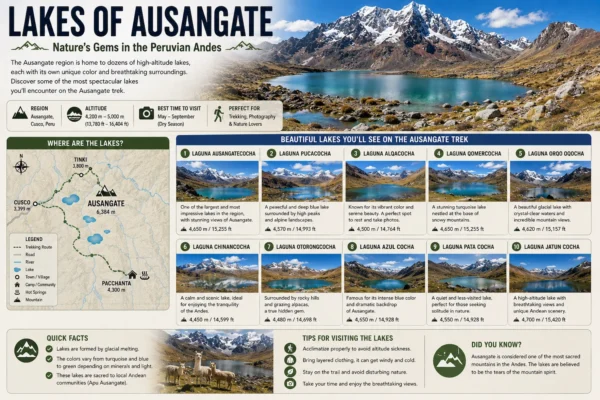
Lakes of Ausangate The Lakes of Ausangate are among the most spectacular natural features…
Wildlife on the Ausangate Trek
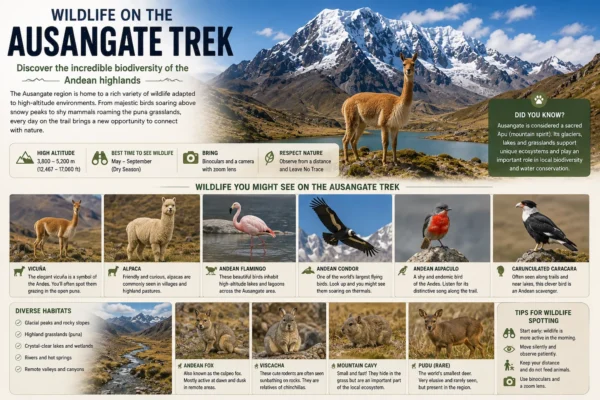
Wildlife on the Ausangate Trek The wildlife on the Ausangate Trek is adapted to…
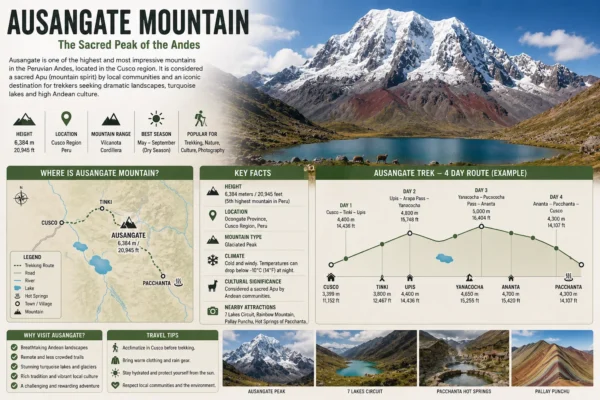
Ausangate Mountain Ausangate Mountain is one of the highest and most important mountains in…
Related Tours