
Wildlife on the Ausangate Trek
The wildlife on the Ausangate Trek is adapted to one of the harshest environments in the Peruvian Andes. Much of the route crosses high-altitude grasslands, wetlands, rocky mountain passes, and glacial valleys above 4,000 meters (13,123 feet).
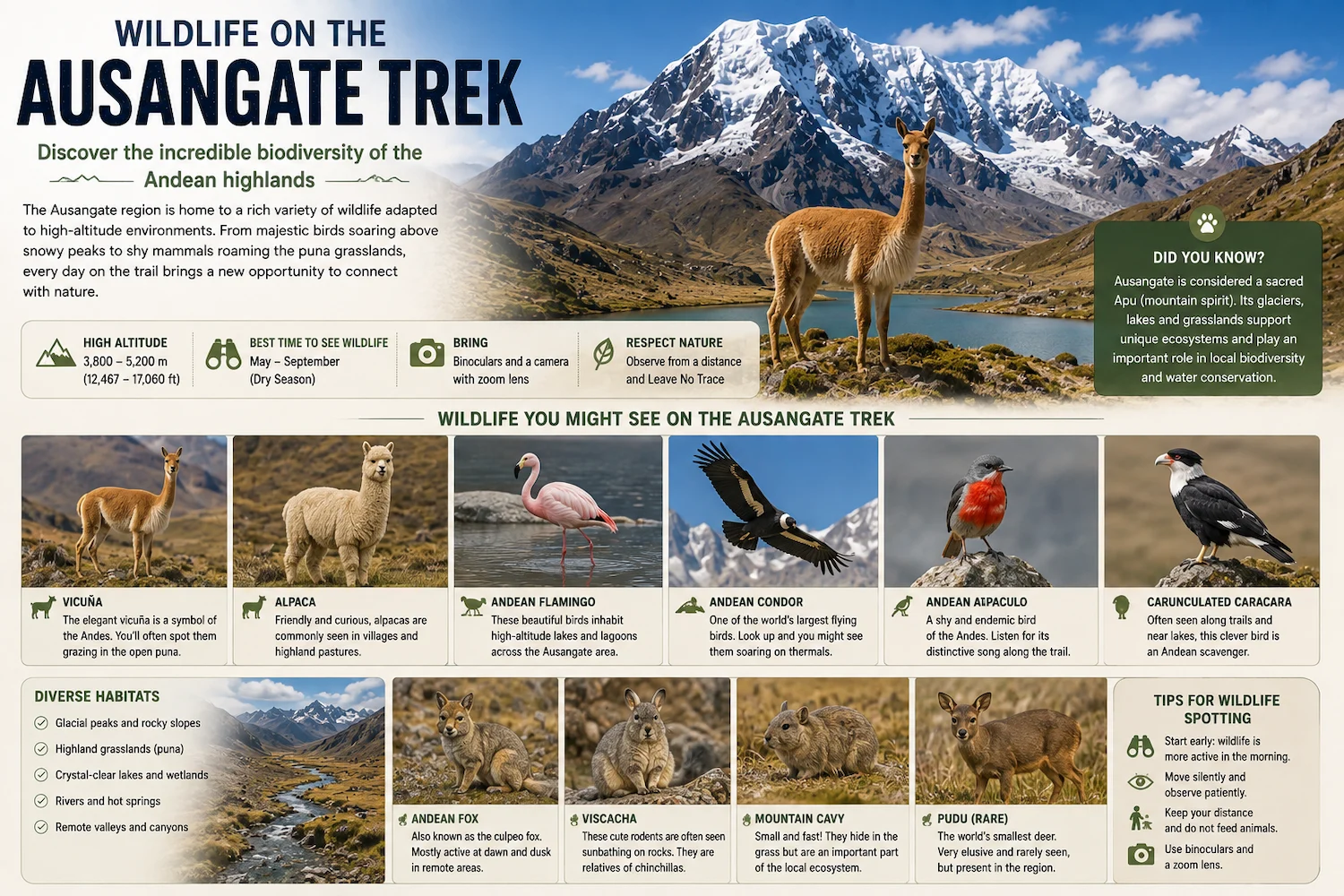
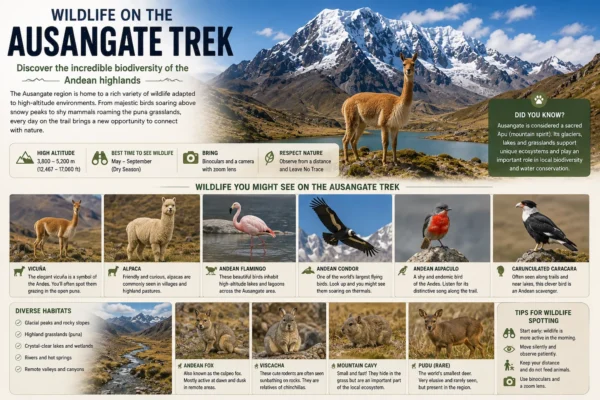
While Ausangate is best known for its glaciers, turquoise lakes, and dramatic mountain scenery, trekkers can also encounter vicuñas, vizcachas, Andean geese, caracaras, and numerous high-altitude birds.
You will also see many alpacas and llamas along the route. These are domesticated rather than wild animals, but they are an essential part of the landscape and traditional life around Ausangate.
Wildlife sightings are never guaranteed, especially for rarer species, but knowing what to look for makes the trek considerably more interesting.
What Animals Live Around Ausangate?
The Ausangate region belongs to the high Andean puna ecosystem, where animals must survive cold nights, strong winds, intense solar radiation, limited vegetation, and elevations that frequently exceed 4,000 meters.
Animals you may encounter include:
| Animal | Chance of Seeing It | Where to Look |
|---|---|---|
| Alpaca | Very common | Grasslands and communities |
| Llama | Common | Villages and trekking routes |
| Vicuña | Possible | Open puna |
| Vizcacha | Possible | Rocky slopes |
| Andean goose | Common | Lakes and wetlands |
| Giant coot | Possible | High-altitude lakes |
| Andean gull | Common | Lakes and valleys |
| Mountain caracara | Possible | Open valleys and cliffs |
| Andean condor | Rare | High ridges and open skies |
| Andean fox | Rare | Remote valleys |
Some species are considerably easier to spot than others.
Alpacas
Alpacas are probably the animals you will see most frequently on the Ausangate Trek.
Large herds graze throughout the high-altitude grasslands surrounding the mountain.
They are particularly important to local communities because they provide fiber and form part of traditional pastoral livelihoods that have existed in the Andes for generations.
Alpacas are domesticated animals, not wildlife.
However, they are such an important part of the Ausangate landscape that it would be impossible to describe the trek without mentioning them.
You may encounter hundreds of alpacas during a multi-day circuit.
Llamas
Llamas are another domesticated camelid commonly associated with the Andes.
They are larger than alpacas and have historically been used as pack animals for transporting goods through mountainous terrain.
You may encounter llamas around communities, campsites, and grazing areas along the Ausangate route.
Some trekking operations also use llamas or horses to transport equipment.
Vicuñas
The vicuña is one of the most interesting wild animals you may encounter around Ausangate.
Unlike alpacas and llamas, vicuñas are wild South American camelids.
They are smaller and more slender than alpacas, with light brown fur and distinctive white coloring around the chest.
Vicuñas generally prefer open high-altitude grasslands where they can detect predators from a distance.
They are naturally cautious and usually remain far away from people.
If you see camelids moving freely across an isolated hillside without shepherds nearby, look carefully—they may be vicuñas.
Vizcachas
Vizcachas are another characteristic animal of the high Andes.
At first glance, they can look like a strange combination of a rabbit and a large rodent.
They have:
-
Long ears
-
Thick fur
-
Long tails
-
Powerful hind legs
Vizcachas typically live among rocky slopes, cliffs, and boulder fields.
Their gray-brown coloring provides excellent camouflage against the rocks, which means trekkers can walk surprisingly close without noticing them.
Early morning can be a good time to look for them sitting on rocks warming themselves in the sun.
Andean Fox
The Andean fox, also known as the culpeo, inhabits mountain environments throughout the Andes.
It resembles a large fox and has reddish-brown fur, a pale underside, and a long bushy tail.
The species can live at high elevation, but sightings on the Ausangate Trek are relatively uncommon.
Andean foxes generally avoid people and may be more active when trails are quiet.
Seeing one should therefore be considered a fortunate wildlife encounter rather than something you should expect on every trek.
Andean Condor
The Andean condor is one of South America’s most famous birds.
With a wingspan that can exceed 3 meters, it is one of the largest flying birds in the world.
Condors use rising air currents to soar above mountain landscapes while searching large areas for carrion.
They occur throughout parts of the Andes, but seeing a condor on the Ausangate Trek is not guaranteed and should be considered relatively rare.
If you see a very large bird circling high above the mountain ridges without frequently flapping its wings, it may be worth stopping for a closer look.
Mountain Caracara
Mountain caracaras are birds of prey that inhabit high-altitude areas of the Andes.
They are more adaptable than condors and may occasionally appear around open valleys, campsites, and areas where food is available.
Their dark bodies contrast with lighter markings around the neck and head.
Watch the sky and rocky slopes as you hike through open sections of the Ausangate circuit.
Andean Geese
The Andean goose is one of the easier high-altitude birds to recognize.
Adults have predominantly white bodies with contrasting dark wings and tails.
Pairs can often be found around:
-
Wetlands
-
Mountain streams
-
Grasslands
-
Glacial lakes
The numerous lakes around Ausangate provide suitable habitat for several species of aquatic birds.
Giant Coots
High-altitude lakes in the Andes can also support giant coots.
These dark aquatic birds are considerably larger than many other coot species and are adapted to living in cold mountain wetlands.
They build large nesting platforms from aquatic vegetation.
When passing lakes during the trek, take a few moments to scan the shoreline and open water rather than focusing only on the mountains.
Andean Gulls
Andean gulls are common around lakes, wetlands, rivers, and open high-altitude landscapes.
Unlike the gulls most travelers associate with coastal environments, these birds live thousands of meters above sea level.
They are relatively easy to identify when flying above the glacial lakes encountered along the route.
Other Birds on the Ausangate Trek
Bird diversity around Ausangate extends beyond the larger species.
Depending on the season, elevation, habitat, and exact route, trekkers may encounter different:
-
Ground-tyrants
-
Sierra finches
-
Plovers
-
Ducks
-
Geese
-
Raptors
-
Hummingbirds in lower areas
Wetlands and lake environments are particularly useful places to stop and look for birds.
Trekkers interested in birdwatching should consider carrying lightweight binoculars.
Wildlife Around Ausangate’s Glacial Lakes
The glacial lakes are not only among the most beautiful features of the trek; they also create important habitats.
Areas such as Pucacocha and other wetlands along the circuit can attract aquatic birds and other wildlife.
You may see birds feeding along shallow shorelines or resting on the water.
The surrounding rocky slopes can also provide habitat for vizcachas.
You can see where many of these lakes appear along the route in our Ausangate Trek Map.
Wildlife in the High-Andean Puna
Most of the Ausangate Trek passes through an ecosystem known as puna.
The puna covers high elevations of the central Andes and is characterized by:
-
Cold temperatures
-
Strong winds
-
High solar radiation
-
Seasonal rainfall
-
Grasslands
-
Wetlands
-
Rocky terrain
Vegetation may appear sparse compared with lower valleys, but these grasslands support camelids and numerous specialized bird species.
The ecosystem also changes with elevation.
Lower sections may contain more vegetation, while areas approaching the highest passes become increasingly rocky and exposed.
The enormous Ausangate Mountain and its glaciers dominate much of this high-altitude environment.
Domesticated Animals vs Wild Animals
It is useful to distinguish between the two.
Domesticated animals
Commonly seen:
-
Alpacas
-
Llamas
-
Horses
-
Sheep
These animals belong to local families and form part of traditional high-Andean livelihoods.
Wild animals
Potential sightings include:
-
Vicuñas
-
Vizcachas
-
Andean foxes
-
Andean geese
-
Caracaras
-
Condors
-
Other high-altitude birds
Wild animals generally maintain greater distance from hikers.
What Is the Best Time to See Wildlife?
Wildlife can be encountered throughout the year.
However, conditions change between the dry and rainy seasons.
During the dry season, trails are generally easier to walk and clear weather can improve visibility across open landscapes.
During the wetter months, the puna becomes greener and wetlands may contain more water, potentially changing bird activity and distribution.
There is no single month that guarantees better wildlife sightings.
If weather conditions are your main consideration, our guide to the best time to hike the Ausangate Trek compares conditions throughout the year.
Best Time of Day for Wildlife Spotting
Early morning can be particularly useful.
Trails are quieter, and some animals may be more active before trekking groups begin moving through the area.
Vizcachas may also emerge around rocky areas as sunlight begins warming the landscape.
Bird activity can vary throughout the day.
While hiking, periodically scan:
rocky slopes → wetlands → lake shores → open grasslands → sky
rather than looking only at the trail.
Where Are You Most Likely to See Animals?
Different habitats attract different species.
Open Grasslands
Look for:
-
Alpacas
-
Llamas
-
Vicuñas
Rocky Slopes
Look for:
-
Vizcachas
-
Small birds
Lakes and Wetlands
Look for:
-
Andean geese
-
Coots
-
Ducks
-
Andean gulls
Open Skies and Mountain Ridges
Look for:
-
Caracaras
-
Other raptors
-
Occasionally condors
Simply knowing where to look can dramatically improve your chances of noticing wildlife.
Wildlife Photography on the Ausangate Trek
Ausangate provides excellent opportunities for combining landscape and wildlife photography.
Alpaca herds against snow-covered mountains are among the classic scenes of the region.
For wild animals, a telephoto lens is particularly useful because vicuñas, foxes, and birds may remain far from the trail.
If photography is important to you, consider bringing:
-
Telephoto lens
-
Extra batteries
-
Lens cloth
-
Weather protection
-
Lightweight binoculars
Remember that everything must ultimately be carried through high-altitude terrain.
Our Ausangate Trek Packing List can help you decide which equipment is actually worth carrying.
How to Observe Wildlife Responsibly
Wild animals should always be observed from a distance.
Avoid:
-
Feeding wildlife
-
Chasing animals for photographs
-
Approaching nests
-
Making excessive noise
-
Leaving food behind
-
Disturbing grazing herds
-
Flying drones close to animals
If an animal moves away because of your presence, you are probably too close.
This is particularly important around nesting birds and wild camelids.
Are There Dangerous Animals on the Ausangate Trek?
Dangerous wildlife is not a major concern on the Ausangate Trek.
The environmental challenges are much more significant than encounters with wild animals.
Trekkers should be more concerned about:
-
Altitude
-
Cold
-
Strong sunlight
-
Weather changes
-
Remote terrain
-
Slippery trails
Our Ausangate Trek Difficulty guide explains the primary challenges travelers should prepare for before attempting the circuit.
Does Altitude Affect Wildlife Watching?
Yes.
The same altitude that shapes the wildlife also affects trekkers.
Much of the route remains above 4,000 meters, which means you may be walking slowly or concentrating heavily on the trail.
Stopping occasionally can actually help.
It gives you time to rest while scanning the landscape for animals.
Before hiking, understanding the Ausangate Trek altitude will help you prepare for the elevations where these animals live.
Frequently Asked Questions
What animals can you see on the Ausangate Trek?
Potential sightings include vicuñas, vizcachas, Andean geese, giant coots, Andean gulls, caracaras, Andean foxes, and occasionally Andean condors. Alpacas and llamas are also extremely common but are domesticated animals.
Are there vicuñas around Ausangate?
Yes. Wild vicuñas inhabit high-altitude puna environments in the Andes and can be encountered in the broader Ausangate region, although sightings are not guaranteed.
Are alpacas wild?
No. Alpacas are domesticated South American camelids raised by Andean communities primarily for their fiber.
Can you see Andean condors at Ausangate?
It is possible, but condor sightings should not be expected on every trek. They range across large mountain areas and are much less predictable than common high-altitude birds.
Are there dangerous animals on the Ausangate Trek?
Dangerous wildlife is not generally considered a significant risk. Altitude, weather, cold temperatures, and remote terrain are much more important safety considerations.
Are there pumas around Ausangate?
Pumas occur across parts of the Andes and can inhabit remote mountain environments, but seeing one on a trekking route is extremely unlikely. They are secretive and generally avoid humans.
What is the most common animal on the Ausangate Trek?
Alpacas are among the animals trekkers see most frequently. Large herds graze throughout the high-altitude grasslands surrounding Ausangate.
Do I need binoculars?
They are not essential, but lightweight binoculars can significantly improve bird and wildlife observation, particularly when animals are far from the trail.
Final Thoughts
The wildlife on the Ausangate Trek is another reason to pay attention to the landscape beyond its famous mountains and glaciers.
Alpaca and llama herds are part of everyday life in the region, while wild species such as vicuñas, vizcachas, Andean geese, caracaras, and occasionally Andean foxes or condors inhabit the surrounding puna.
You are unlikely to encounter large numbers of wild animals at once. Instead, wildlife observation on Ausangate is about noticing individual species within a vast high-altitude environment.
Walk quietly, scan the rocky slopes and wetlands, and keep your distance when you find wildlife.
Combined with the glaciers, colorful lakes, and enormous Ausangate Mountain, these animals form part of one of the most distinctive high-Andean landscapes in the Cusco region.
Related Articles
Ausangate Trek Without a Guide
Ausangate Trek Without a Guide Can you do the Ausangate Trek without a guide?…
How Much Does the Ausangate Trek Cost?
How Much Does the Ausangate Trek Cost? The Ausangate Trek cost typically ranges from…
Lakes of Ausangate The Lakes of Ausangate are among the most spectacular natural features…
Wildlife on the Ausangate Trek
Wildlife on the Ausangate Trek The wildlife on the Ausangate Trek is adapted to…
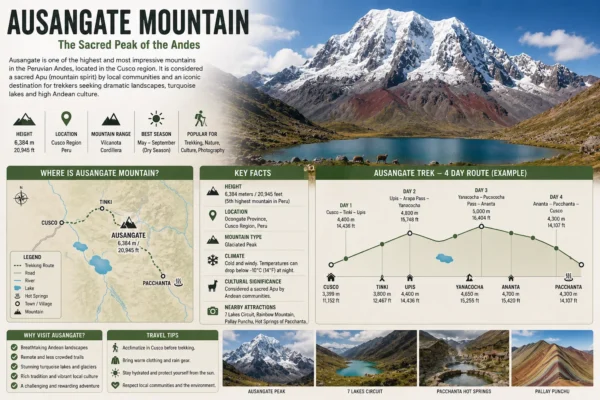
Ausangate Mountain Ausangate Mountain is one of the highest and most important mountains in…
Related Tours