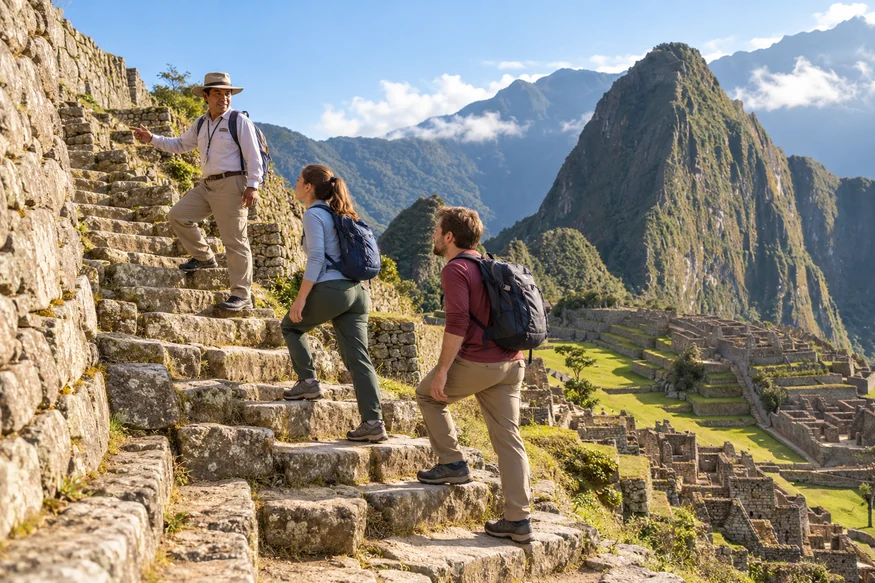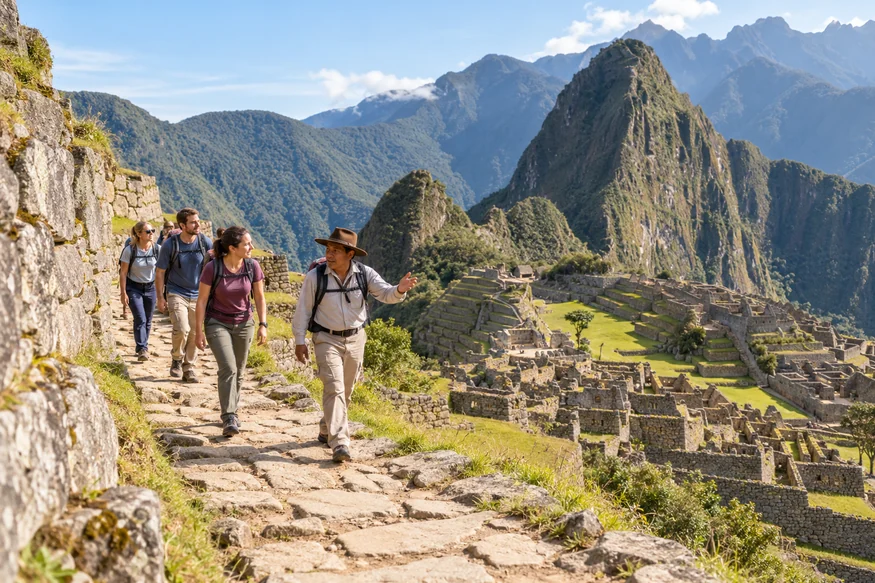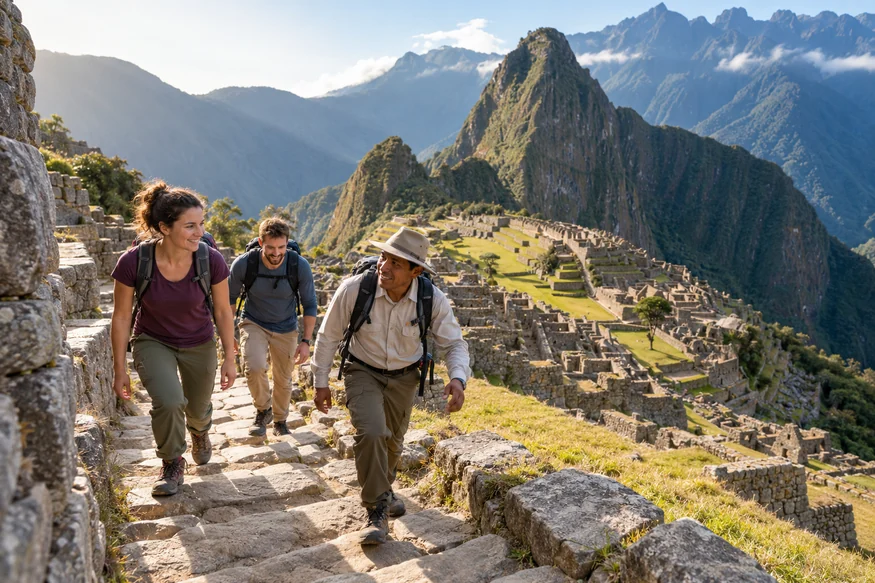

Machu Picchu can be a meaningful journey for travelers with limited mobility, but it requires honest expectations and careful coordination. The archaeological sanctuary was built on a steep mountain ridge, and its protected stone paths were not designed for modern step-free access. Uneven paving, narrow passages, significant stairways and fixed visitor circuits make the experience very different from an accessible museum or city attraction.
That does not mean every traveler with a disability must abandon the idea. It means that Machu Picchu accessibility must be evaluated person by person. The right question is not simply “Can I go?” but “Which parts of this journey match my mobility, transfer ability, balance and support needs?” This guide explains the barriers, the questions to ask and the planning decisions that should be made before booking.
Essential reality: Machu Picchu is not fully wheelchair accessible. A private guide and coordinated transport can improve the logistics, but they cannot remove the original steps, irregular stone surfaces or route restrictions inside the sanctuary.
Is Machu Picchu Wheelchair Accessible?
Not in the usual meaning of a wheelchair-accessible attraction. Standard visitor routes include terrain that can be impossible for an independent wheelchair user and difficult even with assistance. There is no single route that should be advertised as universally accessible because a traveler’s chair, transfer ability, upper-body control and medical needs all affect what may be realistic.
Some transport stages can be arranged more comfortably than the archaeological visit itself. Hotels, train stations and operators may offer assistance, but their equipment and procedures vary. Any promise of a ramp, boarding support, accessible room or suitable vehicle should therefore be confirmed directly and in writing for the exact date and service.
If you use a wheelchair full time, do not rely on photographs or general claims that someone will “help.” Ask precisely where the chair can travel, where transfers are necessary, how many people would assist and what happens if weather or operational rules change. The official Machu Picchu administration provides a contact channel for visitor questions and assistance; use it to confirm current site conditions before purchasing nonrefundable services.
Limited Mobility Covers Many Different Needs
A person who can walk slowly with rest stops has different requirements from someone who can manage only a few steps, uses a rollator, travels with a manual wheelchair or needs help transferring. Before selecting a ticket or tour, describe your abilities in practical terms rather than using only a broad label.
- How far can you walk on uneven ground?
- Can you climb stone steps, and approximately how many at a time?
- Can you stand while waiting or during a transfer?
- Do you need handrails, which are not present throughout the site?
- Can you transfer between a wheelchair, train seat and bus seat?
- What is the weight and folded size of your mobility equipment?
- Do you need another person to assist with balance, medication or personal care?
These details allow a local operator to assess the journey honestly. They are also more useful than age alone. Older travelers who remain comfortable on stairs may find our Machu Picchu guide for seniors more relevant, while travelers with a specific mobility limitation need an individualized access plan.
The Main Accessibility Barriers at Machu Picchu
| Stage | Potential barrier | What to confirm |
|---|---|---|
| Hotel and transfer | Steps, narrow doors and vehicles without lifts | Room access, bathroom setup and transfer method |
| Train journey | Platform gaps, carriage steps and limited equipment space | Boarding assistance, chair dimensions and advance notice |
| Aguas Calientes | Slopes, paving and crowded pedestrian areas | Accessible hotel route and distance to transport |
| Shuttle bus | Boarding steps and uncertain wheelchair accommodation | Current operator procedure for your exact equipment |
| Archaeological site | Stone stairs, irregular ground and narrow one-way routes | Whether any portion matches your verified ability |
The sanctuary is also exposed to rain and strong sun. Wet stone can become slippery, while heat and altitude may increase fatigue. Our guide to Machu Picchu weather helps you understand seasonal conditions, but a final decision should account for the forecast and your personal medical advice.
Choose the Circuit Only After an Accessibility Review
Machu Picchu tickets are tied to defined circuits and entry times. The routes are not interchangeable once you arrive, and the shortest-looking option is not automatically the most manageable. A map cannot fully communicate step height, surface changes, congestion or the places where sitting is unavailable.
Review our explanation of the Machu Picchu circuits, then ask the site administration and a knowledgeable local operator about the current route conditions. Provide a truthful description of your mobility and equipment before the ticket is purchased. Do not assume that staff can authorize an alternative route at the entrance.
Visitors should also read the official Machu Picchu code of conduct. Items such as walking sticks and portable seating are restricted. If a mobility aid is medically necessary, request written clarification in advance instead of expecting an exception on arrival.
Plan the Train and Station Assistance in Advance
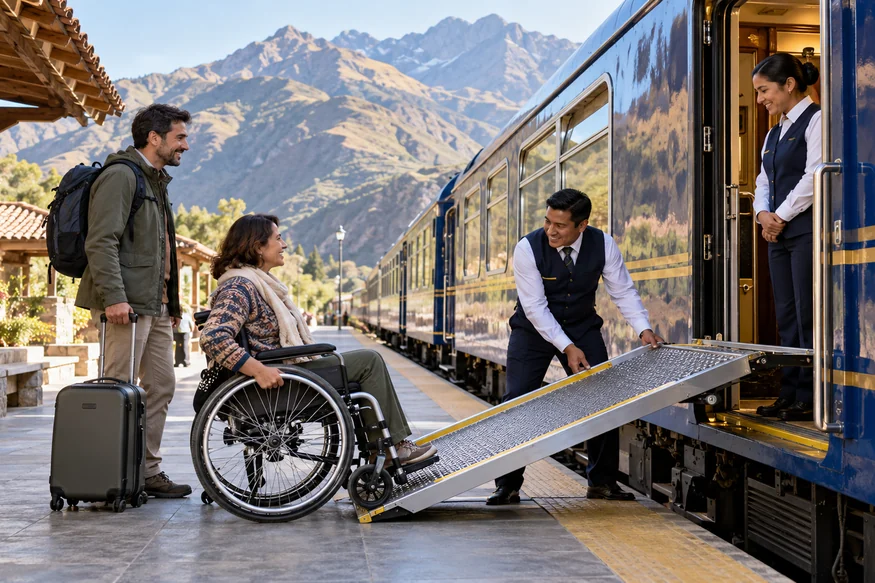
Most visitors reach Machu Picchu Pueblo, also called Aguas Calientes, by train. Boarding can involve steps, platform gaps and a limited time window. Contact the chosen train company before booking and share the wheelchair or mobility-aid dimensions, total weight, folding method and transfer requirements.
Inca Rail states that its Aguas Calientes station has designated ramps and that wheelchair assistance can be requested, but this should be treated as an operator-specific service rather than proof that every carriage or station is step-free. Ask for confirmation of the complete route, including the departure station, carriage access, seat transfer and arrival procedure.
A private itinerary may reduce rushed connections. Depending on your starting point, our train to Machu Picchu guide explains the usual transport chain. The key accessibility principle is simple: every handoff matters. A comfortable train seat does not solve an inaccessible hotel entrance or an unplanned bus transfer.
Understand the Aguas Calientes and Bus Transfer
Aguas Calientes is compact but not uniformly flat. Hotels can differ dramatically in location, entrance steps, elevator access and bathroom design. Request recent photographs and exact measurements if these details affect your independence. “Accessible” should never be accepted as the only description.
The shuttle bus from town to the sanctuary is another separate stage. Confirm the current boarding procedure directly with the operator and explain whether you can climb into a standard bus seat. Do not assume a wheelchair lift or roll-on boarding is available. Our guide from Aguas Calientes to Machu Picchu explains the normal journey, but your access arrangements need individual confirmation.
Spending a night in Aguas Calientes can remove the pressure of combining a long train journey, bus transfer and site visit in one day. It also creates time to solve a transport issue before the scheduled entrance. For some travelers, a carefully paced 2-day Machu Picchu tour may be more realistic than a same-day return.
Can a Guide or Companion Make the Site Accessible?
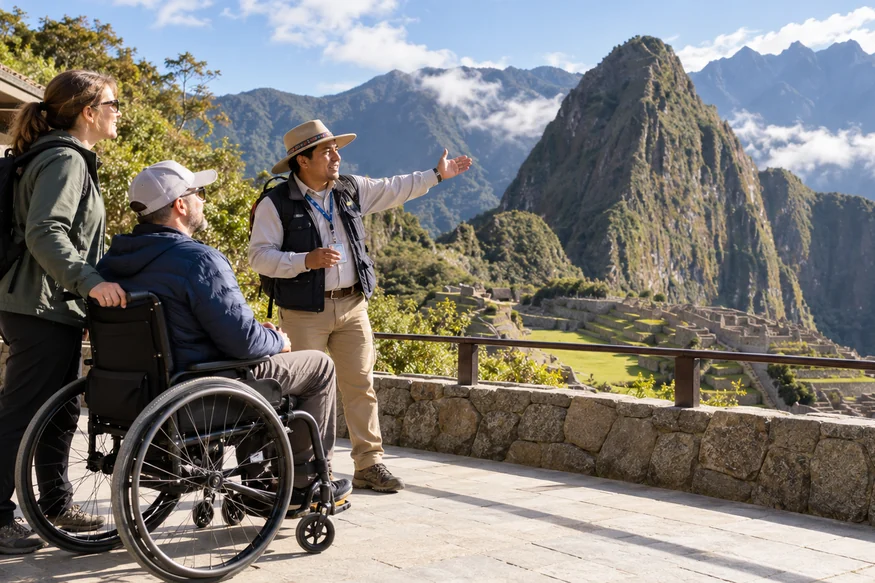
A private guide can make the experience clearer and calmer. They can explain the route, coordinate timing, communicate with local staff and adapt the pace within the rules. A trusted companion may help with transfers, balance or personal care. However, neither a guide nor a companion can transform the archaeological terrain into a step-free environment.
Do not build a plan around carrying a person or wheelchair over long sections. This can endanger the traveler, assistants and protected site. Tour guides are not automatically trained mobility professionals, and physical lifting should never be assumed to be part of their service. If specialized support is essential, define responsibilities and safety limits before booking.
A private tour is most useful when it creates a realistic plan, not when it promises the impossible. Big Foot Machu Picchu can help review transport and pacing, but final access depends on current site rules, provider confirmation and the traveler’s abilities.
A Practical Accessibility Checklist Before Booking
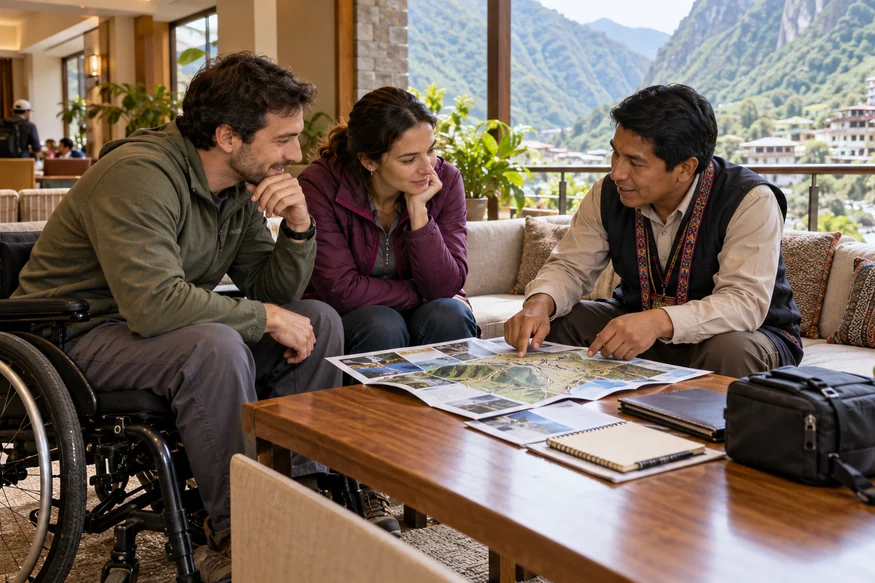
- Speak with your clinician if needed. Discuss altitude, exertion, medication and emergency planning. Machu Picchu sits lower than Cusco, but the journey can still be tiring; read about Machu Picchu elevation.
- Describe functional needs precisely. Include walking distance, stair ability, transfers, balance and personal assistance.
- Document the equipment. Share chair or scooter dimensions, weight, battery type and folding method.
- Confirm each provider separately. Hotel, road transfer, train, station and shuttle arrangements may follow different rules.
- Review the circuit before buying. Tickets can be limited and route changes should not be expected at the gate.
- Ask about mobility aids in writing. The official rules restrict several items, so clarify medical exceptions before arrival.
- Allow extra time. Avoid tight connections and consider sleeping in Aguas Calientes.
- Pack essential medication with you. Keep it protected from heat and rain and follow your clinician’s instructions.
- Arrange suitable insurance. Check medical care, evacuation, equipment damage and pre-existing-condition terms.
- Create an alternative plan. If the verified route is unsafe, choose an experience that preserves dignity and wellbeing rather than forcing entry.
Our Machu Picchu packing list covers general essentials. Travelers with mobility needs should add spare parts, a compact repair kit allowed by transport providers, pressure-relief items and copies of relevant medical information.
Which Machu Picchu Tour Style Works Best?
The best format depends on energy, transfer ability and how much support must be coordinated. A standard group departure may move too quickly and leave little room for individual adjustments. A private itinerary gives more control over departure time, communication and rest, although it still cannot override sanctuary rules.
For travelers who can manage the confirmed route and prefer a shorter trip, a customized version of a Machu Picchu day trip from Cusco may be considered. Those who benefit from a gentler pace should first evaluate the 2-day option. Travelers seeking added comfort can also ask whether the transport elements of the Machu Picchu Deluxe Tour suit their specific needs.
Before reserving, send us a clear description of your mobility, equipment and required assistance. We will help you identify what can be coordinated and what still requires direct confirmation. Honest planning is the best way to protect your safety and make the experience worthwhile.
Plan Your Machu Picchu Visit With Clarity
Tell our team about walking limits, transfers, wheelchair dimensions and medical considerations before tickets are purchased. We will review the itinerary carefully and avoid promising access that cannot be verified.
Frequently Asked Questions About Machu Picchu Accessibility
Is Machu Picchu fully wheelchair accessible?
No. The archaeological site has irregular stone paths, narrow sections and many steps. Transport assistance may be coordinated, but it does not make the protected visitor circuits fully accessible.
Is there a wheelchair-accessible Machu Picchu circuit?
There is no universal step-free circuit that should be promised to every wheelchair user. Current routes and individual needs must be reviewed with the site administration and a knowledgeable operator before buying a ticket.
Can I take a mobility scooter into Machu Picchu?
Do not assume that a scooter will be accepted or usable on the archaeological terrain. Confirm current rules, transport capacity, battery restrictions and equipment dimensions in writing with every relevant provider.
Can I use a walking stick?
The official code restricts walking sticks and similar items. If an aid is medically necessary, contact the Machu Picchu administration in advance and request written guidance about what is permitted.
Will guides or staff carry a wheelchair?
You should not rely on guides or site staff to carry a traveler or chair. Any specialized physical assistance must be explicitly assessed and arranged in advance with safe limits and clear responsibilities.
Does a private tour guarantee access?
No. A private tour can improve timing, communication and logistics, but it cannot remove stairs, change protected routes or override official regulations. Its value is in creating a more realistic and personalized plan.
Should I stay overnight in Aguas Calientes?
For many travelers with limited mobility, an overnight stay reduces fatigue and the pressure of multiple transfers in one day. The selected hotel’s entrance, elevator, room and bathroom should be verified before booking.
Accessibility procedures and visitor routes can change. Confirm current conditions with the official Machu Picchu administration, transport operators and your tour provider before making nonrefundable arrangements.